President Donald Trump’s MAGA movement suffers from an excess of morality. On no issue is that more apparent, and more self-damaging, than immigration.
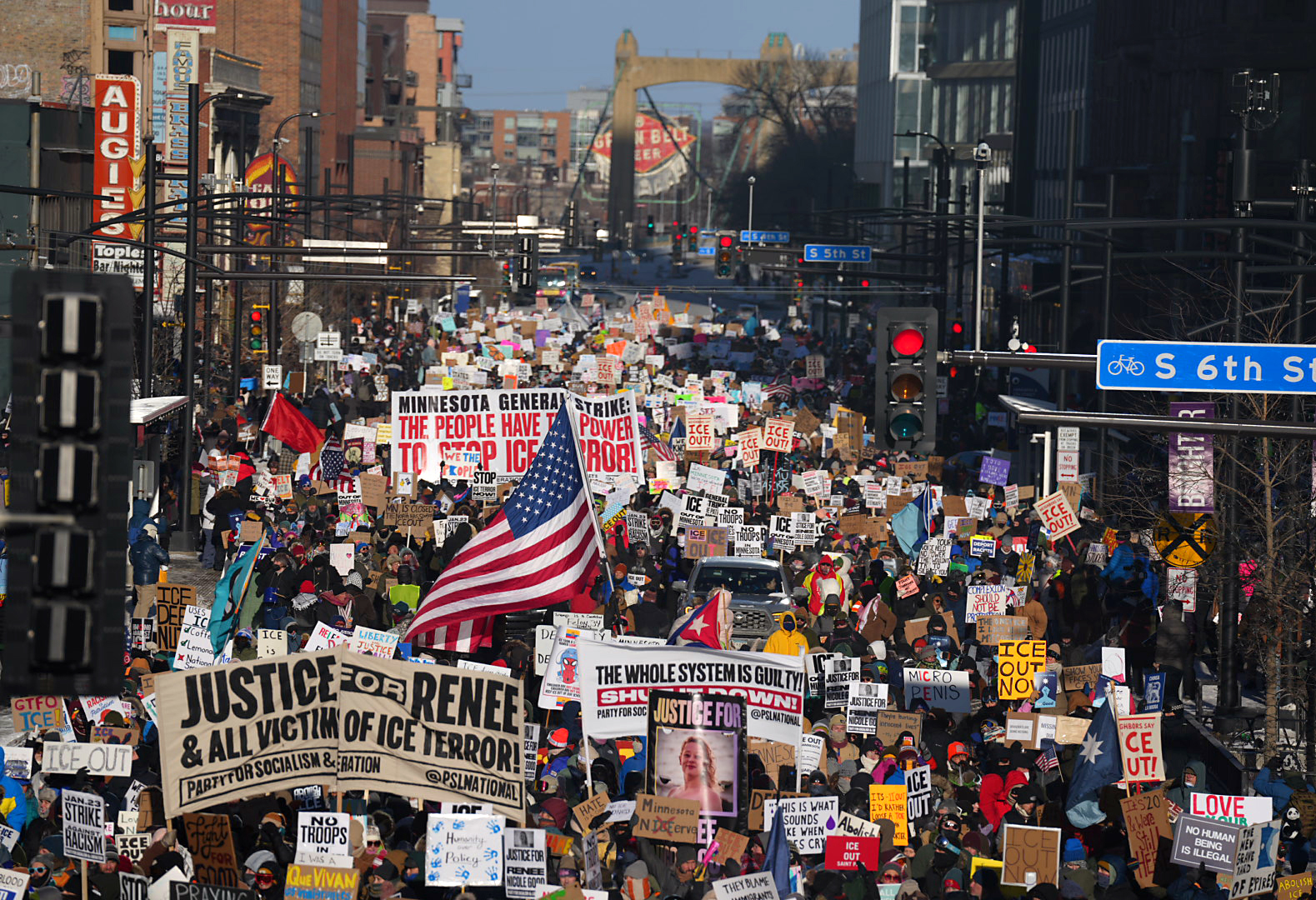
That claim likely would strike both the right and the left as absurd. The former sees itself as hard-nosed realists who will do whatever necessary to take back their nation. And the latter doesn’t see much MAGA morality in Minneapolis, where this weekend immigration officers again shot dead a disruptive protester, the second this month.
Nevertheless, MAGA conservatives have succumbed to the same style of thinking that animates the left, with its “no human is illegal, love is love, kindness is everything” yard-sign ideology. That style of thinking is moralism, a special form of idealism that makes enlightened political judgment and prudent political action nigh impossible. Describing this mental tendency in August, I wrote:
The philosopher Raymond Geuss, in an essay on the historian E.H. Carr, argued that moralism, not utopianism, is the true antithesis of political realism. Moralism, Geuss wrote, is a “complex set of attitudes that give unwarranted priority to moral considerations in explaining and justifying human action.” Often, Geuss added, it amounts to “moralized preaching.”
Once you notice MAGA’s inclination to moralize, you can scarcely unsee it, though it tends to be expressed more abrasively than what you hear in church on Sunday. Consider a recent tweet by the right-wing commentator Matt Walsh of the Daily Wire, who has 4 million followers on X. Satirizing the alleged squishiness of unnamed conservatives regarding the Minneapolis shootings, Walsh wrote:
This ICE situation is really complex. My take is more nuanced. I want our immigration laws to be enforced but I just want them to do it without using any force, and without anyone ever getting hurt, and without anything sad or upsetting happening ever…
The tweet goes on, but you get the idea. Other conservatives took a similar view. “There is no room on the right for anyone who will not stand unequivocally behind ICE, 100%,” wrote Gavin Wax, an influential staffer at the State Department. “No hedging. No half-measures. No ‘I support them, but’ lectures.”
For Wax and Walsh, any nuance on this issue distracts from the ideal of justice as they conceive it and from the relevant principle they derive from it: Illegal immigrants broke the law by coming here, so they should be deported.
I agree with that principle, and I probably subscribe to the same ideal of justice as they do, more or less. But that’s not the end of the matter. From the standpoint of real politics, it’s not even the beginning.
Realism, as the cliché goes, deals with the world as it is, not as it should be. And in America, the political reality is this: Trump was elected to solve the immigration crisis, but public approval of his immigration policy has plummeted, and the decline seems to be accelerating amid the Minneapolis crisis. Evidently, Americans don’t like the sight of masked immigration officers on the streets roughing up and occasionally killing protesters.
Now, I agree with right-wingers who point out that the killed protesters had been actively impeding law-enforcement operations, and that they plausibly had threatened or seemed to threaten the safety of the officers who killed them. And those facts should be pointed out to leftists who pretend that Trumpian Brownshirts are gunning down random Americans. But the right-wingers’ observations amount to a moral (and legal) appraisal, which misses the political significance of the controversy.
The growing unpopularity of Trump’s approach to immigration signals looming political disaster for the MAGA movement. The president himself has said he thinks immigration was the main issue that motivated Americans to elect and reelect him, and that’s a plausible read. The upshot? If Americans come to prefer the Democrats over the Republicans on immigration, it could be lights out for the GOP in the midterms and in 2028.
In other words, if you, like me, want Vice President J.D. Vance to become President J.D. Vance three years hence, then you need to grapple with the political reality of immigration enforcement, however inconvenient. Of course, if no viable alternative to Trump’s deportations policy existed, the political reality would be different, and the moralists would have a better argument. But alternatives do exist.
For example, the Republican Party could revive a policy proposal that has fallen out of favor: mandatory national E-Verify. That’s the program that enables businesses to determine the eligibility of employees and applicants.
If all businesses were required to use it, then foreigners would have less incentive to sneak into the country and illegal aliens less incentive to stay. “If you have a mandatory E-Verify program, it’s game over for illegal immigration in the United States,” Andrew Arthur of the Center for Immigration Studies told me last year. Some experts say the president can implement E-Verify through executive action.
Businesses that rely on cheap illegal labor would object, but forcing them to hire Americans and other eligible workers would surely be politically more fruitful than the current approach, which yields sob stories and mass protests and violent imagery and sanctimonious Democratic politicians. Arrests and deportations would still be needed, but armed immigration agents could be more selectively deployed.
Some right-wingers might object that the scale and urgency of mass migration makes unrelenting state force necessary. I agree that America and the Western world as we know them will be forever lost if we don’t halt and reverse mass migration, which our nations never voted for.
But surging immigration officers into liberal cities isn’t achieving this goal at scale, even as it’s galvanizing the left and discrediting right-wing populism. If we don’t find broadly palatable solutions and the Democrats, seizing the advantage, return to power, they’ll simply turn the immigration hose back on, justice be damned.
Of course, morality can still play a role in political thinking, just not the all-encompassing and determinative one that moralists ascribe to it. And it can still play a role in rhetoric as well. Appeals to abstract justice often mobilize an audience, inspiring allies and winning converts to one’s political side. (And moralized preaching is a better path to 4 million X followers than nuance will ever be.)
But as Aristophanes knew when he mocked Socrates, the morally better argument often loses to the worse when the winner is established by public sentiments. His point, I think, was that we should rethink what “better” and “worse” mean in political debate, and revise our moral expectations accordingly.
Politics is war, and winning the immigration battle is a moral imperative. But at this moment, prudence counsels a tactical retreat, followed by a stealthier, better-targeted attack. I predict that Trump, a battle-hardened anti-moralist, will listen to prudence.
The post On Immigration, MAGA Needs Less Morality appeared first on The American Conservative.