All major countries, such as Germany, Japan, and Australia, have a network of consulates across the United States. These consulates engage in many legitimate diplomatic activities, such as trade promotion and cultural outreach, as well as serving as platforms to assist their citizens. Los Angeles is home to over 90 consulates, while Chicago has over 80
The largest consulate networks are maintained by migrant-sending countries, such as Mexico, Honduras, Guatemala, El Salvador, and others, all with massive national diasporas in the United States. For these governments, their activities in support of their citizens in the U.S. dwarf all their other diplomatic activities. Mexico, with some 40 million persons in El Norte, around 5 million illegally present, has the largest network with an unprecedented 52 consulates scattered across the American interior.
El Salvador has 22 consulates attending to the needs of its huge migratory population. Some 25 percent of all Salvadorans live in the U.S.; over 1 million are illegal migrants. Honduras has 15 consulates, supporting 1 million illegal migrants; Ecuador, 13 consulates and over half a million illegals; the Dominican Republic, 11 consulates and 200,000 illegals; and Colombia, 13 consulates, 400,000 illegals. It is a long list that goes beyond the Western hemisphere and includes other countries like India and the Philippines.
Although poorly understood by Americans who have virtually no contact with them, these consulates contribute in subtle (and sometimes not subtle) ways to America’s ongoing immigration chaos and lawlessness. All diplomats dedicated to this support work—known in the trade as consular officers—have a legitimate right to assist their citizens, including even those unlawfully present. But the problem is that many of these consulates have openly joined forces with America’s domestic sanctuary resistance movement. Consulates are off the reservation when their diplomats are conspiring against and resisting Trump administration policies to detain and remove illegal migrants.
Almost all migrant-sending countries consider the Trump administration’s goals to carry out large-scale repatriation of their citizens against their national interest. Mexico, El Salvador, and others want to maintain their vast populations, including the illegals, anchored in the United States—working, receiving benefits, and serving as conduits for more future migration. Massive repatriations would cut the vast remittances foreign nationals send home (which provide, for example, Mexico some $65 billion annually and make up a staggering 25 percent of El Salvador’s economy). Moreover, the massive return of migrants threatens the fragile status quo in all these sending countries.
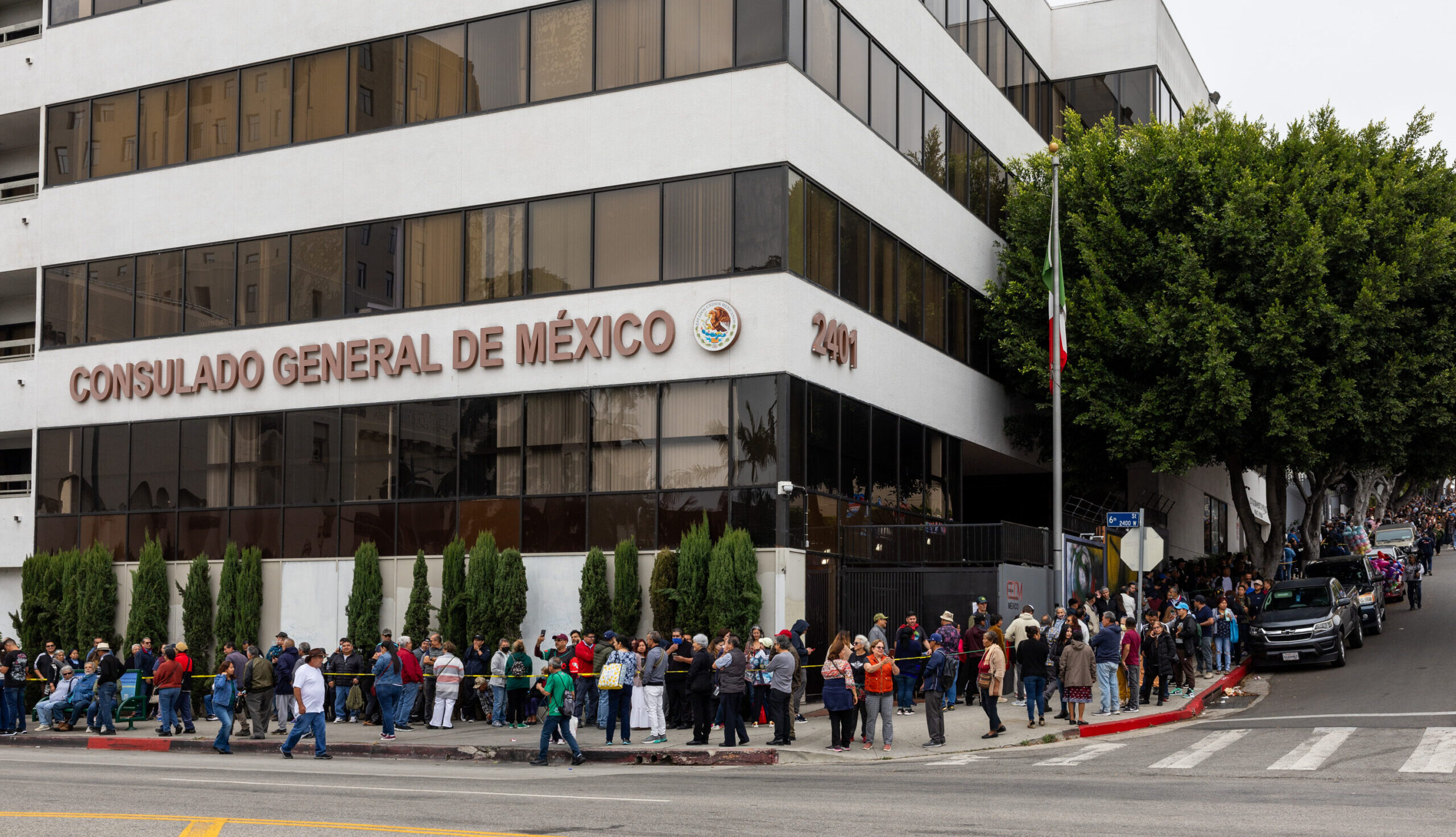
It is no surprise that these foreign consular networks are natural allies with radical American sanctuary activists, journalists, NGOs and local officials. A typical example is Los Angeles Mayor Karen Bass, who traveled to the inauguration of Mexico’s President Claudia Sheinbaum to trumpet their common values. The mayor and president cheered Los Angeles as the world’s second-largest “Mexican city” and committed to a strong ideological alliance on migration issues. LA authorities and the city’s large Mexican consulate are implementing that partnership by thwarting federal ICE agents. Bass is the face while Mexican diplomats operate behind the scenes.
Most sanctuary cities are following the same strategy: forbid federal agents from using city property or resources and create so-called ICE-free zones, as Mayor Brandon Johnson proclaimed in Chicago. Working with foreign consular officials, city authorities also “document” illegal migrants (issue them “identity” cards), as Denver has done, so the foreigners have “lawful status.” All these sanctuaries encourage spies to monitor, observe, and share intelligence on ICE agents, their movement, and locations. This latter kind of information, of course, was provided to radical activists like Alex Pretti who was killed in Minneapolis as he harassed ICE agents.
Foreign consular officers are particularly valuable to the resistance apparatus because of their exceptional communication and feedback lines into migrant communities. In Chicago and other cities, Mexico runs its so-called “consulates on wheels” (mobile consular staff) that move through migrant neighborhoods, under diplomatic status, to collect information and warn its nationals about ICE enforcement raids. In addition, consular officers are allowed to meet with arrested migrants, making it possible for diplomats to go inside federal holding facilities and collect even more information.
Foreign consulates not only work with sanctuary city officials, but also with a wide network of migrant NGOs, church groups, Democratic politicians, and anti-ICE American activists. One particularly effective part of these nullifiers consists of legal advocacy groups like the Coalition for Humane Immigrant Rights (CHIRLA), the National Immigrant Justice Center (NIJC), and others. These groups use gathered information to go to federal court to litigate before like-minded judges. Interestingly, the Mexican government actually provides resources or funding to CHIRLA and other NGOs, which helps them to sue the Trump administration. Many American observers might believe that foreign governments should not be bankrolling NGOs to thwart U.S. federal law.
The existence of these consulate networks demonstrates how Washington’s domestic immigration law enforcement, like it or not, is also front-line U.S. foreign policy. It is the U.S. State Department—specifically, the Office of Foreign Missions—that has the first responsibility to monitor and determine whether foreign officials are engaging in conduct inconsistent with their diplomatic privileges or consular status. It is State that has legal authority to accept or reject the requests of foreign governments to open consulates outside of their embassies in Washington.
In all of this, State is guided by the rules set down in the obscure Vienna Convention of Consular Relations, an international treaty that governs the activities of consular officers in foreign countries. The Vienna Convention authorizes diplomats to work on behalf of their citizens through recognized consular activities, e.g., providing legal assistance in individual cases, emergency financial loans, and needed documentation. But diplomats are supposed to stay very clear of open public advocacy in the host country. Going to social media to denounce federal law enforcement, conspiring with sanctuary city officials, and funding lawsuits through NGOs should be considered activities inconsistent with the Vienna Convention. Such conduct should result in diplomats being declared persona non grata and the closure of consulates.
In managing this panoply of foreign consulates, the State Department has regrettably lost the thread of U.S. national security interests. For example, State authorized consulates for Honduras, El Salvador and Guatemala in obscure border cities such as McAllen, Texas, because those governments wanted their diplomats to assist their nationals after illegally crossing the southern border. Moreover, illegal populations are rewarded, because their numbers are used in the calculus to determine how many consulates a foreign government should be permitted.
Similarly, the State Department has been heedless of the fact that illegal diasporas over decades have flocked to sanctuary cities and states, particularly in California, Illinois, New York, and Massachusetts. Secretary Marco Rubio’s new leadership team in Foggy Bottom needs to remake the mistaken mindset prevalent among too many State officials that the department has no role in domestic enforcement of U.S. visa laws and unlawful presence statutes.
State must no longer ignore the fact that many foreign consulates have gravitated from passive activities against the implementation of U.S. immigration law to, as in the Mexican example, active resistance to Washington’s policies. Mexico’s 52- consulate network in the United States is the largest of any foreign government in another single country, by far, in the world. Exercising dubious judgment, the State Department authorized Mexico to open 21 consulates general and 31 consulates. (A “consulate general” is a larger facility with more staff than a consulate; in a few cases, a consulate general may even be bigger than the parent embassy in Washington. While there are slight legal differences, for all practical purposes, these buildings and their staff enjoy the same immunities and privileges that accompany an embassy.) All the Mexican consulates are staffed by career diplomats; none of these 52 is an “honorary consulate,” which is typically run by one unpaid, part-time staffer working out of a home or private office.
Peter Schweizer’s new book Invisible Coup documents that the Mexican consular network in the United States is doing much more than issuing passports. These consulates, in fact, are the backbone of a fifth-column strategy to maintain control of the Mexican diaspora in the U.S. with the goal of resisting assimilation, holding on to the second generation, and exercising political influence in Gringolandia. The former Mexican President Andrés Manuel López Obrador, known as “AMLO,” built out this network and bluntly mobilized it to engage in partisan activities such as resisting the election of Donald Trump and undermining U.S. border security measures. Typical of this was AMLO’s smear campaign against Florida’s law criminalizing human smuggling (AMLO predictably called it “racist”) in which the Mexican president had his consular envoys denounce Florida’s Governor Ron DeSantis.
When President Joe Biden was in the White House, he never once rebuked his Mexican counterpart’s political meddling, nor instructed the State Department to expel any Mexican diplomats. Now, with Trump back in the saddle, President Sheinbaum is much more cautious than AMLO, but her diplomats have still crossed the line into unacceptable activities, as Schweizer’s book clearly documents.
The State Department should start by reducing the number of accredited foreign consulates from countries with large numbers of unlawfully present nationals. Those consulates ripe for closing are the ones conspiring with the most defiant sanctuary cities; certainly, Los Angeles and Chicago should be on the target list. The howl of disapproval will be vociferous, but none of these sanctuary cities has any authority, beyond State Department’s permission, to host a Mexican or any other foreign consulate. The State Department can act quickly in these matters, when it wants, as it showed in shuttering the Chinese consulate in Houston in 2020 over spying concerns.
Like the affected sanctuary cities, foreign governments will vehemently protest and threaten tit for tat retaliation, but those will be empty threats. Despite the possible diplomatic contretemps, the U.S. objective is not to start an unnecessary squabble with Mexico (although Trump would certainly win such a brouhaha), but to signal to Sheinbaum and to her successors that bilateral migration issues are now fundamentally different. Just as the Trump administration has secured the southern border, Washington will no longer tolerate the Mexican government’s turning its diplomats into policy advocates on U.S. territory.
Now is the time to act. Mexican and other consulate activism is part of America’s deep immigration chaos. The State Department must address this problem.
The post Close Foreign Consulates in U.S. Sanctuary Cities appeared first on The American Conservative.