Why Would the Kurds Do America’s Dirty Work?
Everyone’s favorite Middle Eastern minority has been left out to dry one time too many.
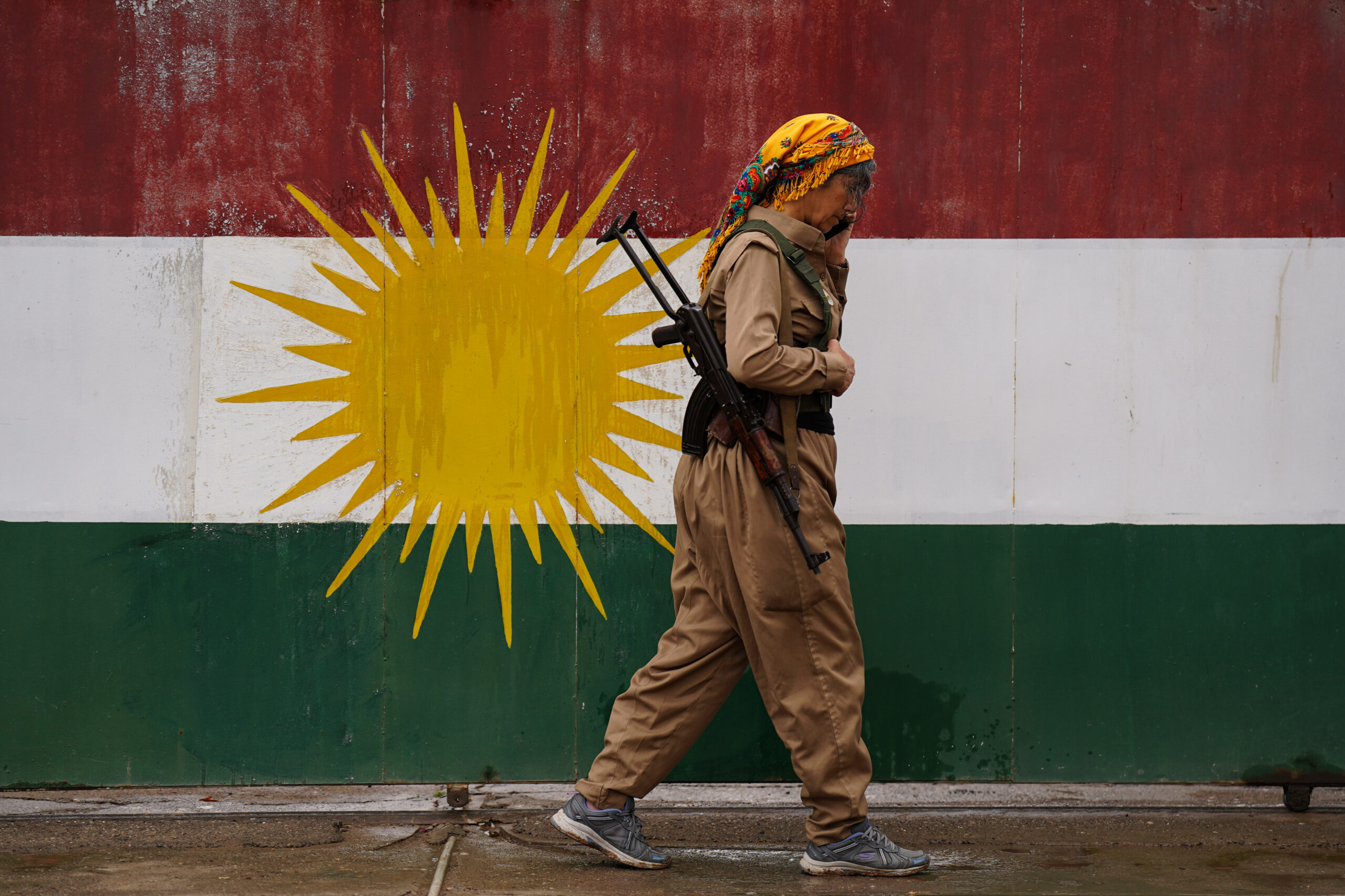
Will the Kurds fight the government in Tehran at Washington’s urging, opening a new ground front in Iran? The U.S. seemingly wants them to, but the Kurds and Washington have a sordid history on this topic. What will Kurdish leaders advise their people to do?
Imagine you are one of those Kurdish leaders today, in, say, your mid-sixties. You grew up hearing your elders talk of the collapse of the Ottoman Empire and its division by the Allies. After WWI, the Kurds were given the prospect of an independent homeland with the Treaty of Sèvres. When the Turks rebelled, however, that plan was shelved. Instead, the Kurdish-inhabited lands home to some 30 million people were split among what would later become Turkey, Iraq, Syria, and Iran. Whole nations, such as Iraq, were casually sketched onto a map of the Middle East (within those impossibly straight border lines you see today) to match European power schemes. Although Sèvres and its follow-ons were not signed by the U.S. (which was too weak in the area then to play power politics with the Europeans), the Western abandonment of Kurdish statehood was set: Kurdish aspirations would be subordinated to the geopolitical priorities of stronger states. As a Kurdish young man, these were your early lessons.
The post–Second World War rise of American power did little to make the Kurds feel the West saw them as anything more than cannon fodder. U.S. foreign policy focused on maintaining stable alliances with Turkey and the Shah’s Iran as critical bulwarks against Soviet influence. Supporting Kurdish independence would have threatened those alliances, as both sought to put down their Kurdish minorities. The U.S. briefly sent arms via Israel and Iran to the Kurds, but more to use them as troublemakers to keep Saddam Hussein on his toes. Even that minor effort ended abruptly with the 1975 Algiers Agreement between Iran and Iraq. Iran withdrew its support for the Kurds as part of the border settlement, and the United States followed suit. The episode was the first example that Washington, too, would walk away from the Kurds when geopolitics suited it. Our young man would have heard tales of the fighting, and then of the abandonment in the field by the United States, from the uncles who made it home alive.
The worst of it all came in 1988 when the Iraqi military attacked Halabja, a Kurdish town in northern Iraq, with chemical weapons. Some 5,000 civilians were killed. After Saddam’s military was expelled from Kuwait in Gulf War 1.0, President George H. Bush encouraged Iraqis to rise up against Saddam Hussein. Kurdish groups in northern Iraq rose in violent rebellion. When the United States did not intervene to support the rebels, however, they were brutally crushed. Under pressure, Washington established a no-fly zone in northern Iraq under Operation Provide Comfort, which protected Kurdish areas from the worst of the Iraqi attack. As an unintended consequence, this allowed the establishment of the Kurdistan Regional Government (KRG). This was the closest Kurds ever came to self-government. Our Kurdish leader was now a man and likely fought the Iraqis himself, believing at first in U.S. support. He was unlikely to have met the retired American Green Beret I did, whose eyes welled with tears years later in a North Carolina bar describing the moment he was ordered to walk away and leave his Kurdish comrades.
During the Iraq War, Kurdish fighters worked side-by-side with U.S. forces to topple Saddam. But in 2005, the U.S.-dictated Iraqi constitution specifically excluded Kurdish independence in favor of a “unified” Iraq. In 2017 the Kurdish people held an independence referendum, which the United States opposed for fear of destabilizing Iraq and antagonizing Turkey and Iran. The United States did not intervene on the Kurds’ behalf when the Baghdad government, now closely aligned with Iran, retook disputed territory, including the oil-rich city of Kirkuk. Our Kurdish leader would have most likely participated in these events, met with American envoys promising independence with fingers crossed behind their backs, and watched as America again weighed regional aims against Kurdish hopes. In the local style he would have referred to the Americans as “my friends” even as he knew the term lacked validity.
One might think that would have been the end of friendly American-Kurdish relations. Instead, another chapter unfolded during the 2014 war in Syria when Kurdish militias became the United States’ most effective local partner in the fight against Islamic State. For Kurdish leaders in Syria, this partnership in blood appeared to again signal long-term American backing for a self-governing Kurdish region. But in 2019 President Donald Trump withdrew many U.S. troops from Syria and allowed Turkey to launch military operations against Kurdish forces it feared had eyes on Turkish border lands.
So spare a thought for our Kurdish leader, now an elder in his group and possibly one of the key leaders who received guests from the CIA recently bearing small arms and maybe a phone call from Trump himself, making big promises. According to one U.S. official, a goal would be to “take over a specific territory in the Kurdish region inside Iran in order to challenge the regime and inspire a broader uprising.”
But unlike those American officials, our man knows his history, having survived it. He is once more being asked to throw his young soldiers into war on behalf of the U.S., hoping this time Kurdish needs will somehow align closely enough with American war aims in Iran to benefit him. Promised air cover, he will weigh carefully any Western history he may recall, such as about the Bay of Pigs, when similar promises were made.
Or will the Turks pressure the U.S. to abandon him again? Will his men just be used as bait to draw out Iranian ground forces? Will a U.S. deal with Iran leave him alone again, useless as spilled water on the sand? No way, many will say, ignoring the sad reality that time after time the Kurds believed America and went into a fight alongside her. When someone writes the next version of all this history, what will the concluding paragraph say about our Kurdish leader in 2026? The Kurds have learned to survive every empire that promised them a nation. The question is whether they have finally learned to distrust one.
The post Why Would the Kurds Do America’s Dirty Work? appeared first on The American Conservative.