
Is America a Republic? Or an Empire?
Ron DeSantis leads a tutorial on liberty—and tyranny.
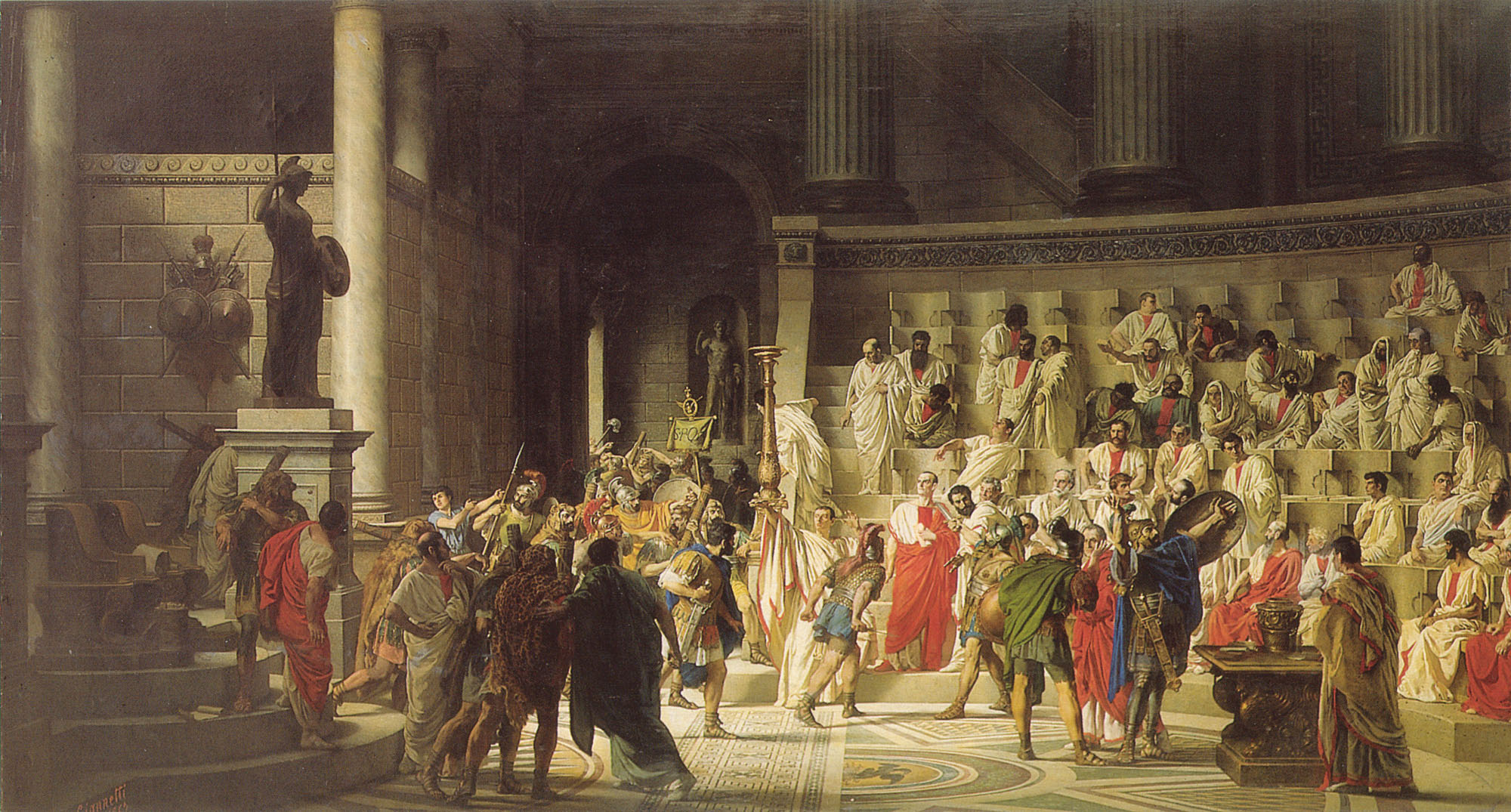
Florida’s Gov. Ron DeSantis has taken time away from running the country’s third-largest state to talk ancient history—literally. Those seeking perspective on troubling current events are better off for this trip down memory lane.
The colloquy started on March 30, when DeSantis X-ed (tweeted) out praise for The Golden Thread: A History of the Western Tradition. “Looks like a volume worth having, especially as we approach America 250,” DeSantis X-ed, adding, “The Founders were products of the Western tradition and they looked to its entire history—from the ancients to the Enlightenment and everything in between—for inspiration and guidance in justifying the revolution and, later, when creating the Constitution.”
An Xer asked DeSantis, “What do you think they took away from the ancients?” The governor answered, “Standard for civic virtue. Refusal of power (Washington/Cincinnatus). Statesmanship (Cicero). Opposition to tyranny (Brutus).” To which an X-er snapped, “Yep no tyranny happened in Rome after they executed Ceasar [sic].” It’s in the nature of X-course that hot takes—along with spelling errors—come tumbling forth.
Yet DeSantis was rolling with it: “Uh, yeah, which is why the Founders detested Caesar. They viewed the fall of the Roman republic as a civilizational tragedy.”
Those words exercised some X-ers; they were soon reaching for their rhetorical weapons. One post unsheathed the gladius: “Sad to see RDS go down this unsound path – better the Caesar who did so much for #SPQR than the multitude of popinjay Ciceros and Catos whose Lilliputian conniving did so much damage to Rome & made Caesar indispensable.”
Another post hurled the pilum: “In the story of the fall of the Roman Republic it was Julius Caesar who was the good guy. The aristocratic and corrupt senators like Cato, who refused to address the issues facing the common people and republic were the bad guys.”
Still another sought to put in the pugio: “Julius Caesar did nothing wrong. The Optimates had spent the last 100 years kicking Roman citizens off their land so the rich could replace them with foreign slave labor. They killed every reformer who tried to stop them. Caesar was the moderate option. They killed him too.” Threads included visual hymns to a Caesar-ized Donald Trump.
As his duties in the Sunshine State were no doubt pressing against him, DeSantis closed down the colloquy: “It’s not a question of what I think. It is simply a fact that American political culture at the time of the founding was pro-republic and anti-Caesar. That worldview informed the Founders’ political judgments and influenced the formation of American political institutions.” Yet the Floridian couldn’t resist a post-script: “Rome was a cautionary tale about the fragility of republics, the need for civic virtue, and the susceptibility of republics to degenerate into tyranny.”
This historical debate, engaging politics and culture, too, has ebbed and flowed for more than 2,000 years, and will flow on. Caesar has many American fans—in Las Vegas they named a casino after him—and yet fans of American liberty know that autocratic Germans and Russians came up with “Kaiser” and “Czar,” respectively, to communicate their affection for the ancient Roman. To borrow the gambling phrase, that’s a tell.
Yet beyond the person of Julius Caesar, there’s the broader question of the law-bound Roman Republic as it transitioned—violently—into the more lawless Roman Empire.
In recent times, two very different figures, Gore Vidal and Pat Buchanan, made similar points: That the American Republic was yielding to something new and unwanted: an American Empire.
“We have embarked upon empire (Rome born again our heavy fate),” Vidal wrote in 1956. Having repeated the point for decades, in 1997 Vidal added, “July 26 was the 50th anniversary of the National Security Act that, without national debate but very quiet bipartisan congressional support, replaced the old American Republic with a National Security State very much in the global-empire business.”
Buchanan, a cofounder of this magazine, was not normally in accord with Vidal, and yet he shared this foreboding. In 1999, he published A Republic, Not an Empire: Reclaiming America’s Destiny. The book was was a dire minority report, challenging the foreign policy consensus. “We Americans have been behaving like the Roman Empire,” Buchanan declared, citing evidence of imperial overreach, just in the preceding decade: Military interventions in Panama, Kuwait, Somalia, Haiti, and Bosnia; bombings IN Sudan, Iraq, and Libya. In the quarter-century since, we’ve seen many more actions, including full-blown wars of choice. (Buchanan’s one reference to Vidal was to note that back in 1940, he had joined the anti-interventionist America First Committee.)
We must hasten to say that the Roman Republic was not Switzerland. In fact, both the Roman Republic and Roman Empire fought wars all the time. The key distinction between Republic and Empire was not pacifism, but process. The “SPQR” mentioned earlier meant something in the Republic. They were the Latin initials for “The Senate and People of Rome,” inscribed on coins, flags, and public buildings. Which is to say, “SPQR” appeared on the things Romans made, thought were important, and wanted everyone to see. It was the vocabulary of legitimacy, the permanent pledge that the system was guided by law and lawful rulers.
In 49 BC, fresh from a foreign war, Julius Caesar upset this order. Defying the Senate, he and his army crossed the Rubicon; their aim was to overthrow the Republic. After years of fighting, that’s what they did. In 44 BC, Caesar was declared dictator perpetuo. (Just few weeks later, that perpetuity came to a sudden end; Caesar was assassinated on the floor of the very Senate that he had trounced.)
DeSantis is right that most of the Founders detested Caesar. Yet of course, when active minds are gathered, there’s never unanimity: Alexander Hamilton admired Caesar, and another Founder, Caesar Rodney, who actually signed the Declaration of Independence, had that first name—he couldn’t have hated Caesar too much.
Yet John Adams spoke for most Founders when he put Caesar in a pot with other tyrants, all guilty of “enslaving their country, and building their own greatness on its ruins.” Adams listed a few more of these rogues, adding bleakly, “and ten thousand others.”
To be sure, while they were not nearly as warlike as the Roman Republicans, the American Republicans were not peaceniks. They were willing to fight the British, of course, and also, if the need arose, the French, the Spanish, and “the merciless Indian Savages.”
Yet still, the Founders were too genteel to overtly admire the actual murder of Caesar. Instead, they emphasized the old republic’s rule of law—the very thing, of course, that Caesar had trampled.
So the Founders identified their hero, a contemporary of Caesar, whom DeSantis also hailed: Cicero. Even before this most famous of Roman lawyers, the state had asserted, Bellum nullum nisi justum (No war except a just one). That stipulation didn’t stop many wars, but at least it put war-making power in the hands of duly commissioned guardians: the Senate, of course, but also priests, soothsayers, and other keepers of mos maiorum—the thick web of Roman custom that guided public, as well as private, behavior. Distributed power maintained the rule of law in the Roman Republic; exactly what the Founders hoped to see in their own new republic.
Cicero laid out all these legalities in his magisterial work, De Officiis (On Duties), completed in 44 BC: “In the case of a state in its external relations, the rights of war must be strictly observed.” In that same juridical manner—anticipating international law—he continued, “The only excuse, therefore, for going to war is that we may live in peace unharmed.”
Knowing that Caesar had by then extinguished the republic, Cicero added, forlornly, “We should still have at least some sort of constitutional government.” The following year, 43, the great jurist was killed by political enemies.
Yet Cicero’s principles—“What people have always sought is equality of rights before the law”—survived him; indeed, they have proven immortal.
No wonder Adams—surely the most legally erudite of the Founders—heaped so much praise upon Cicero. Adams saw in the Roman’s writings “the principles of nature and eternal reason . . . that all men by nature are equal; that kings are but the ministers of the people; that their authority is delegated to them by the people, for their good, and they have a right to resume it, and place it in other hands, or keep it themselves, whenever it is made use of to oppress them.” These eternal principles, Adams concluded, inspired righteous opposition to tyrants across the ages, against Caesar in the 1st century BC, and against George III in the 18th century AD.
Indeed, since the American Revolution, “caesarism” has been mostly an epithet, applied, for instance, to Alexander Hamilton and to his great rival, the man who killed him, Aaron Burr. In 1838, young Abraham Lincoln warned against Caesarism, and yet in 1865, the 16th president’s assassin, John Wilkes Booth, leveled the same charge. In the 20th century, Franklin D. Roosevelt was routinely jibed as a Caesarist; always in on the joke, the 32nd president celebrated his birthday by dressing up in a toga.
In 1959, the great right-winger James Burnham published Congress and the American Tradition, an ode to Article One of the Constitution, the section designating the powers—in Burnham’s view, the superior powers—of the legislature. And yet Burnham warned of then-regnant liberalism: “In our own day we are able to see its final goal and resting place, the end-term of the process which it sets into motion. This end is: Caesar.”
Some might wonder, of course, if all these Caesar-sightings constitute “crying wolf.” Perhaps. Or perhaps they might be the cumulative vindication of what we might dub the Vidal-Buchanan Thesis.
So now to the 45th and 47th president. Back in 2018, he was painted with the Caesar brush—by no less than Mary Beard, author of a best-selling history of Rome. And now, with the Iran War, the “c-word”—caesarism—accusation is coming faster and more furious.
One wonders if any of this bothers Trump. As a natural high-stakes player, he might be flattered by the comparison; after all, as a subset of the endless fascination with the Romans, many today think Caesar is cool, including prominent Trump fans.
Caesar’s eternal appeal is that he cuts through the crap to get (bleep) done. He is a strong man of bold action. Which, of course, is what Adams warned most against. As he wrote in 1798, “human Passions unbridled by morality and Religion. Avarice, Ambition, Revenge or Galantry, would break the strongest Cords of our Constitution as a Whale goes through a Net.” And that’s how Caesarism breaks liberty and breeds tyranny.
In that same spirit, small “r” republicans—many of them clustered around this magazine—who oppose the Iran war are left to wonder: How many capital “R” Republicans will join them? Ron DeSantis, so loquacious on historical Caesarism, has supported the fighting, albeit, as a governor, he’s not front and center. Among elected officials in Congress, beyond those stubborn Ciceronians, Sen. Rand Paul and Rep. Tom Massie, the ranks of Republican opponents are indeed thin.
Of course, the Constitution is neither antiwar nor pro-war. It simply insists that process be given its due—in this case, most likely, the War Powers Resolution, the 1973 law in which Congress sought to clarify the powers that it should have had all along.
In the meantime, we are in a moment of constitutional hinge. Those cheering for a commander-in-chief acting beyond the writ of Congress should ask themselves: How will they feel if some future Democratic president acts as a blue dictator perpetuo, launching a sudden and unilateral war against, say, climate change or transphobia?
As Adams also wrote to his wife Abigail, cities can be rebuilt, and impoverishment recovered from. “But,” he warned, “a Constitution of Government once changed from Freedom, can never be restored. Liberty once lost is lost forever. When the People once surrender their share in the Legislature, and their Right of defending the Limitations upon the Government, and of resisting every Encroachment upon them, they can never regain it.” Hmm. Lose liberty, lose the legislature, lose limitations on government.
So if we can’t keep our Republic, we lose a lot.
The post Is America a Republic? Or an Empire? appeared first on The American Conservative.