Muddling Through on the MOU
It’s too early to see through the fog of warring and negotiating, but J.D. Vance’s stock is rising—with Trump’s backing.
Over 250 years of U.S. history, Wikipedia tallies some 500 American military interventions. Some we remember, and most—such as the First and Second Sumatran Expeditions—we don’t.
So now today, amidst all those hundreds, where will the Iran War fit in? Wise minds say of the impact of great events, “It’s too soon to tell.” In the meantime, the stock market is up (the Dow Jones is up some 3,000 points from where it was on February 28) and oil prices are way down from their wartime peaks (albeit still higher than before the war started). All this could change at any time; the fog of war, and related confusions, has barely lifted.
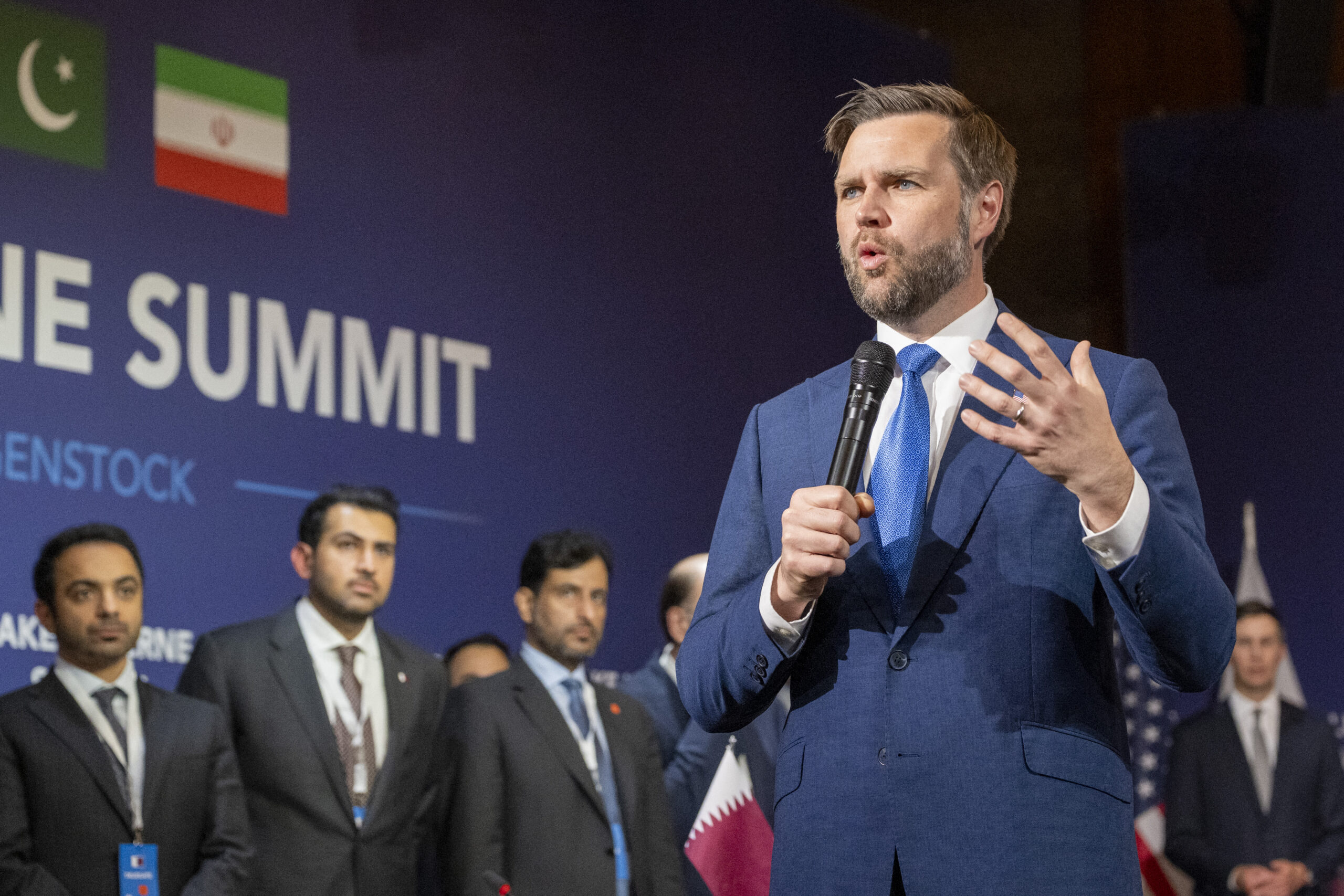
Still, on June 22, speaking from Switzerland, Vice President J.D. Vance was crisp as he outlined the U.S.-Iran Memorandum of Understanding. That is, he was precise, albeit not soaring; his brief was littered with lawyerly Greco-Latinates: “mechanisms,” “process,” “technical teams,” “deconfliction.”
What’s happening here ain’t exactly clear, and yet, for what it’s worth, the Americans and Iranians, aided by diplomats from Qatar and Pakistan, seem to be aiming to create enough procedural guardrails so as to absorb any future shocks. Notably, Israel says it’s not bound by the agreement, and nobody would presume to speak for every last fighter from the three H’s: Hezbollah, Hamas, and the Houthis.
In the words of Axios’s Barak Ravid, a close chronicler of Iran events, “The nearly nonstop talks at the Lake Lucerne Summit signal both sides remain engaged despite significant differences and may be laying the groundwork for broader discussions of regional security.”
Okay, so there’s lots happening on the diplomatic front. But what about in the Persian Gulf itself? Here’s a June 21 New York Times headline: “What Changed After Almost Four Months of War? Analysts Say Not Much.”
That story provoked a furious reaction from President Donald Trump. “REALLY?” he roared, ripping the newspaper as “corrupt and failing,” and the editorial team as “unethical cowards.” Trump added of Iran: “Their Military is DONE, their Navy is GONE, their Air Force is GONE, their Launching Pads, Missiles, Drones and Manufacturing of same, is almost GONE, their top two sets of Leaders are GONE.”
Of course, enough Iranian leaders survived to reach this MOU. So in that sense, the MOU represents a muddle: The Iranian regime has been bloodied, but not changed; it still stands and defies. In fact, it seems to have taught the U.S. military a lesson on drones that a puzzled Pentagon is having trouble processing.
Still, like a good pudding, this muddle has a theme. In the cool assessment of The American Conservative’s Andrew Day, “What Trump has actually accomplished is to reframe the Islamic Republic as a legitimate actor in world affairs, rather than a Forever Enemy whose very existence America can scarcely tolerate.” Could it really be that half-a-century of hostility is being dissipated, or at least mitigated? Again, we’ll have to see which way the fog bank rolls.
Yet we do know Vance was joined in Switzerland by two presidential chums, Jared Kushner and Steve Witkoff. Their presence signaled that this new discourse has plenty of Trump fingerprints. Meanwhile, another pillar, Treasury Secretary Scott Bessent, announces that sanctions on Iranian oil, a linchpin of American policy for decades, have been temporarily lifted.
Needless to say, this much diplomatic churn is churning the critics, left and right. In response, X-er Peachy Keenan asked her 145,000 followers: “Why is everyone mad at the one guy who got it right? J.D. was the one voice of sanity, and his star is rising because of his foresight and wisdom. He understands: Americans are not in the mood to go to war abroad.” She added an assertion still to be tested: “That ship has sailed away, for good.”
To be sure, the pro-war voices have not abandoned ship. Indeed, the craftiest of these, Sen. Lindsey Graham (R-SC) is charting carefully. He seeks to separate Trump from Vance—dubbing the latter “the architect of the deal.” Why? Perhaps to stay in good with Trump, and perhaps further, to boost some non-Vance candidate for the 2028 Republican presidential nomination.
Will this stratagem work? It hasn’t yet, that’s for sure. Administration officials are stout in their defense of the Trump-Vance tandem, as are their outside skirmishers, jousting with critics and pointing to potential benefits, including for U.S. farmers. And Turning Point USA’s Andrew Kolvet asked deal-bashers a hard-to-answer question: Do you want to send in ground troops to “finish the job”?
Indeed, no less than Donald Trump Jr. unleashed a barrage of pro-deal, pro-Vance Xes. Furthermore, the younger Trump podcasted to Sen. Bernie Moreno (R-OH), “The attacks on J.D. Vance this week by the neocons and bot farms are kind of amazing. I was with my father this weekend and it seems like J.D. Vance is just doing what my father actually wants him to do. They won’t attack my father, so they try to go after J.D.”
And as for any possible impact on ’28, Laura Ingraham points out that Polymarket oddsmakers show Vance going up. (And on Kalshi, as well.)
So yes, the situation might be a muddle, and yet at this moment, fog willing, Vance is shining.
The post Muddling Through on the MOU appeared first on The American Conservative.