As Burnham Gains Support, Britain Keeps Going Backwards
The Conservatives should become again the party of sound money and secure borders.
Britain is not just getting poorer, it’s going backwards: back to the politics of the 1970s, to state controls, high taxes, and big public spending. According to YouGov polls, voters want nationalization of utilities, wealth taxes, rent controls, even a return to the European Union.
And Labour is eager to oblige.
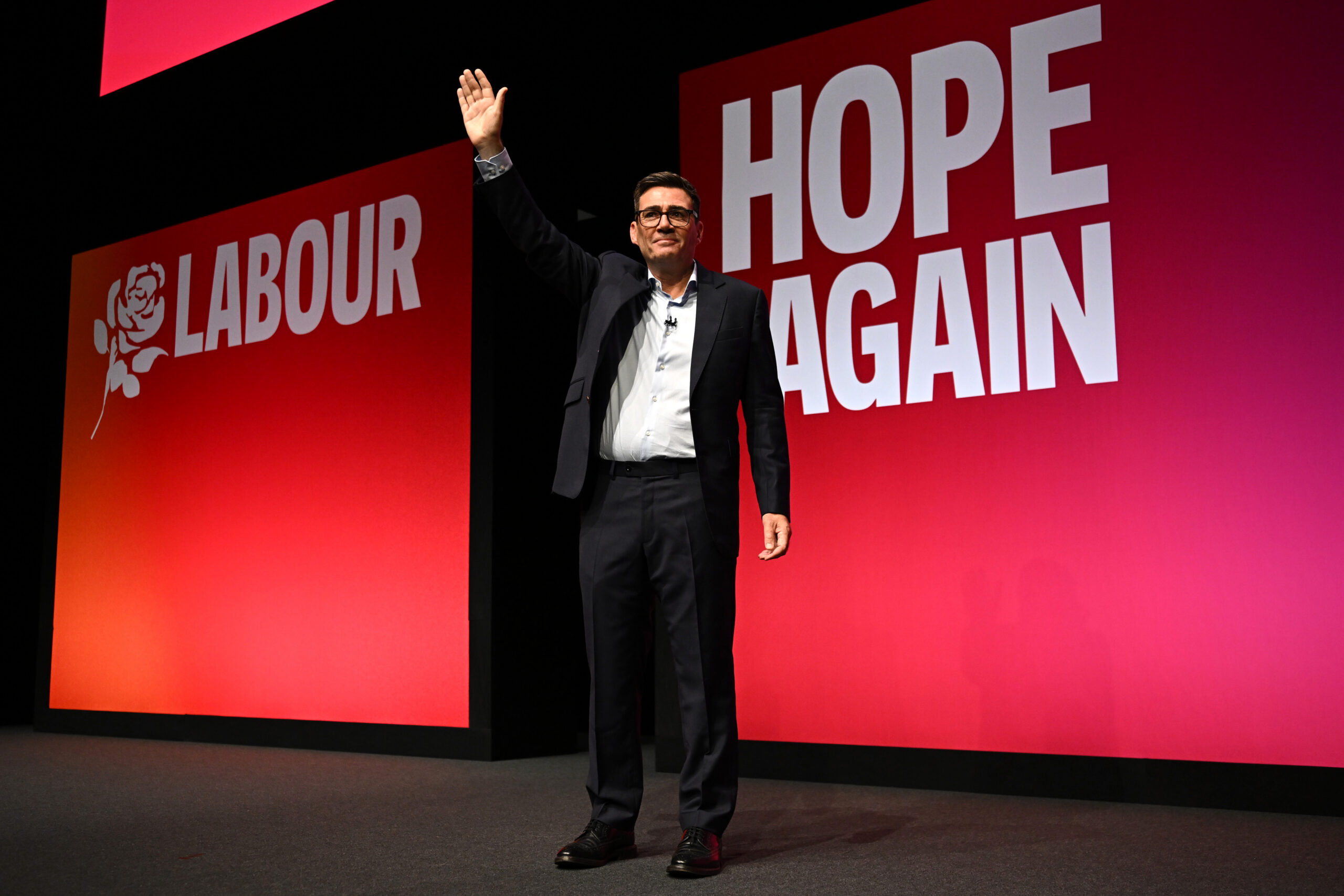
The increasingly popular Labour Prime Minister Andy Burnham sealed the deal at his party’s conference in Liverpool last week with a highly emotional speech full of old left-wing tropes that had the attending delegates in tears of joy. He lamented the “wrong path” taken forty years ago by Margaret Thatcher. The age of neoliberalism is over, he says.
This week, the Conservative leader Kemi Badenoch, at her party’s conference in Birmingham, will try to explain why going backwards is a bad idea. Badenoch needs to remind people just what Britain was really like in the era Burnham eulogizes.
In the 1970s, great British industries like shipbuilding, car manufacturing, and steelmaking were effectively destroyed by powerful trade unions and weak management. Coal miners forced the government to impose a three-day week on industry, as flying pickets caused power cuts across the land. Nationalized utilities like rail, water, and power were notoriously inefficient.
Burnham’s golden age climaxed in 1976 when the Labour Chancellor Denis Healey had to go cap in hand to the International Monetary Fund for a loan after inflation peaked at 27 percent and international bond markets shunned UK debt.
The markets appear to be doing so again. After Burnham’s speech last week, the 30-year gilt yield briefly broke 6 percent—the highest level for 30 years. Some believe that the current Labour chancellor, John Healey, may end up following his 1970s namesake to the IMF if London continues to ramp up borrowing and taxation.
Mind you, it wasn’t all bad in the ’70s. Governments at least kept their borders relatively secure and did not allow thousands of young men from conflict zones to enter Britain illegally. It was reported last week that two such men were arrested for plotting to stage another attack on British Jews.
Badenoch might also usefully remind Burnham that when Labour’s Jim Callaghan was prime minister in the mid-1970s, he appreciated the value of North Sea oil. He would have regarded Labour’s ban on new drilling licences in the middle of an energy crisis as “turkeys voting for an early Christmas,” to use one of Sunny Jim’s favourite put-downs. It was exactly 50 years ago at the Labour conference in 1976 that Callaghan told his party that post-war Keynesianism had run out of road.
“We used to think we could spend our way out of recession,” he said. “I tell you in all candour that that option no longer exists.” He went on to tell the stunned delegates that wealth had to be created before it could be distributed. In this, Callaghan anticipated Thatcher’s free-market counterrevolution. Healy imposed spending cuts equivalent to 2 percent of GDP, despite furious attack from the “Toytown Trots,” as he called the Labour hard left. This repudiation of state socialism went on to become the basis of Tony Blair’s election victory in 1997.
The irony is that only 20 years ago, Burnham was a staunch supporter of Blair, now regarded as a neoliberal pariah. Labour’s most successful prime minister, who won three straight elections after 1997, retained most of Thatcher’s deregulation, privatisation, and trade union reforms.
Indeed, the era that Burnham depicts as 40 years of failure was actually a rather successful one for the UK. Growth and wages rose faster than ever in the ’80s and ’90s, and Britain’s national output and international credit recovered. The nation largely prospered until 2008, when an international financial crisis, partly precipitated by irresponsible bank lending, brought national growth and productivity to an abrupt halt.
It is not easy to explain exactly what went so wrong after the Global Financial Crisis. But the resulting economic failure was not caused by a lack of socialism. Indeed, since then taxation has risen to the highest levels since the 1950s, as public debt rose to over £3 trillion, largely through increased welfare spending. Immigration rose to nearly 1 million net in 2023, the highest influx ever.
And it was a Conservative government under Boris Johnson who invited in the migrants in the so-called “Boriswave.” Badenoch will have to eat a large slice of humble pie for her party’s responsibility for these catastrophic errors. But at least she can say that they were an aberration. Conservatives have traditionally been the party of sound money, secure borders, and economic growth.
The Tories are also now the party of Brexit. In her speech Tuesday, Badenoch will warn Britons that Burnham’s surprise announcement that he intends the UK to rejoin the EU betokens another five years of division over the most toxic issue in British politics.
But that appears to be what British voters want. A plurality also say they favor introducing proportional representation in general elections, another back-to-the-future policy announced by Andy Burnham last week. Though when they actually look at the results of “fair voting,” as in Scotland, where the nationalists have been in power for 20 years on a declining share of the vote, they may think twice.
Burnham insists that he wants “good growth” in every postcode, by which he means government-controlled growth. He believes that taking public control of water, energy, telecommunications, and many large industries will somehow deliver this growth. British voters desire it too, to pay their rising bills, but they also seem to yearn to stifle the very private enterprise that delivers economic growth.
In Britain today there is a positive aversion to capitalism, almost a loathing of the free market. Progressive statism is hugely influential in the universities, media, charities, and the NGOs that dominate the British public square. Many voters want to punish billionaires and ramp up taxes on the better-off. Burnham is going with the grain of informed opinion in the UK.
So it was with renewed gusto that Labour sang the socialist anthem, “The Red Flag,” at the end of their most successful conference in years. Burnham seems to have morphed into a media-savvy version of the left-wing former Labour leader, Jeremy Corbyn.
Perhaps Kemi Badenoch will find some consolation in recalling that in 2019 Corbyn took Labour to its worst election defeat since 1935.
The post As Burnham Gains Support, Britain Keeps Going Backwards appeared first on The American Conservative.