
American Conservatives Don’t Hate Europe
But they do reject the erosion of its civilization.
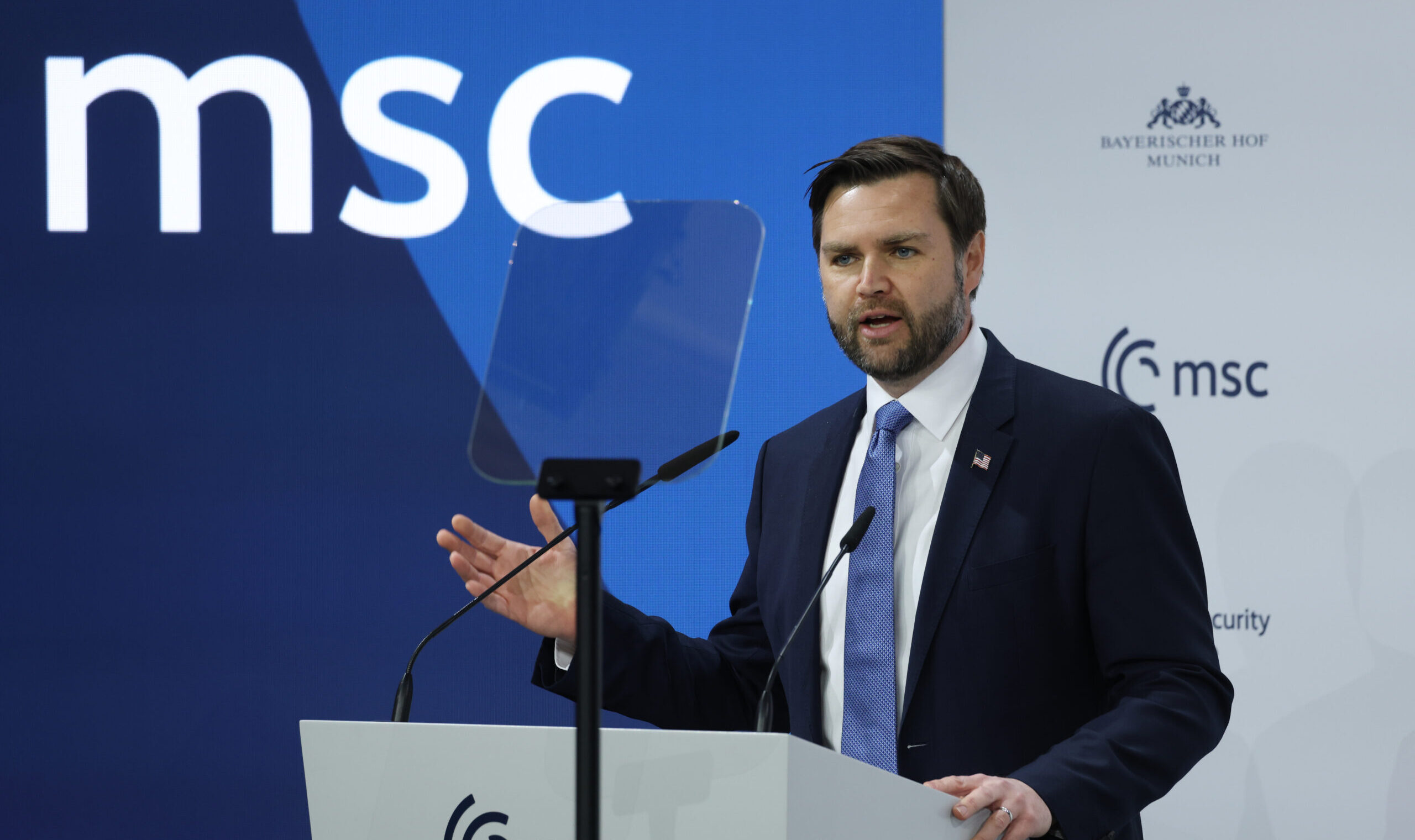
As President Trump prepared to give his address to the annual World Economic Forum (WEF) on January 21, expectations within the transatlantic community were not exactly high. Against the backdrop of escalating tensions over Greenland and tariff threats, Trump delivered an hour-long speech that combined his administration’s accomplishments with pointed criticism of Europe. The continent’s leaders and elites responded with a mix of indignation, defensiveness, and unease—an understandable reaction given the circumstances.
That said, many European responses to the Trump administration’s policies, whether regarding Greenland or the U.S. National Security Strategy (NSS), share a telling common thread. They demonstrate an inability to grasp the administration’s civilizational realist worldview. Most American conservatives do not hate Europe; the continent is just too strategically and culturally linked to America to pretend its governing trajectory is sustainable. A Europe that is unable or unwilling to think and act like a serious power ultimately weakens the alliance it claims to defend.
Contrary to the prevailing perception in Brussels and many European capitals, much of today’s American right-wing criticism stems from an enduring sentimental and civilizational attachment to the continent from which the United States itself emerged. “We believe deeply in the bonds we share with Europe as a civilization,” said Trump in his WEF speech. Vice President Vance echoed this sentiment in an interview several days later: “They are one of our most important allies in the world; we share a common civilizational heritage.”
If these statements did not make it clear enough, the NSS explicitly states that “America is, understandably, sentimentally attached to the European continent.” These expressions sit uneasily with claims that the administration just hates Europe. If America truly viewed Europe with contempt or disregard, it would not repeatedly emphasize its cultural centrality or express concern about its long-term trajectory—whether one agrees with that assessment or not.
At the same time, this administration does approach transatlantic relations through a realist lens, deprioritizing Europe relative to other theaters and reiterating familiar demands around burden-sharing. The United States expects Europe to evolve into an independent security actor. America’s global priorities have shifted toward the Pacific, and the transatlantic relationship now depends on greater European capacity and self-reliance. Many transatlanticists have long conflated deprioritization with betrayal, but only a political class accustomed to dependency interprets realism as abandonment. The disillusionment in Europe over America’s more realist reorientation after Biden stems in part from the fact that realism withdraws the moral deference Brussels has relied on for U.S. protection. Once that deference is questioned, Europe must justify itself on performance rather than the rhetoric of shared democratic values alone.
But what is more concerning is Europe’s seemingly entrenched inability to think in power terms. The Greenland episode is emblematic of this dynamic. While Washington’s approach unsettled allies and strained diplomatic convention, the continent’s reflexive moral outrage treated the issue as sacrilege rather than a strategic question to be negotiated between serious powers. Europe’s purported preparedness to face off against the Trump administration with no hard power to back its rhetoric only further underscored its detachment from great power politics.
This pattern extends well beyond Greenland. Despite possessing far greater latent military capacity and outmatching Russia economically, demographically, and technologically, many European politicians act as if their own survival in the face of Russian aggression depends entirely on American intervention. Most revealing, however, were the reactions from certain NATO leaders who hinted at closer alignment with China in response to the very real transatlantic strain. That suggestion is not merely unserious; it is strategically incoherent to turn toward an authoritarian great power that openly rejects the political, legal, and moral claims that Europe professes to uphold.
These disputes cannot be explained by recent diplomatic friction alone. Beneath the surface lies a more consequential divergence over how Europe is understood. Despite the administration’s affinity for Europe as a civilization, it draws a clear distinction between Europe and the European Union. Many on the American right blame the latter for destructive policies on migration, energy, regulatory overreach, censorship, and the dilution of national sovereignty. They critique a governing worldview that has hollowed out much of Europe’s capacity to think historically, politically, and strategically. Europe’s political class, along with their ideological counterparts in the U.S., can no longer distinguish between Europe as a civilization and the European Union as a managerial project. In this framework, any critique of policy failure is reflexively treated as an attack on European sovereignty and dignity. When institutions come to stand in for civilization, criticism of governance is no longer heard as allied candor, but as an existential affront.
But what most unsettles policymakers in Brussels is the administration’s use of civilizational language. Terms such as “civilizational erasure,” “promoting European greatness,” “national identities,” and “remaining European” are immediately dismissed as xenophobic or extensions of American culture-war politics. A European parliamentary brief highlights how the NSS departs from past iterations in how border security now informs U.S. foreign policy. Immigration is, of course, a politically charged issue on both sides of the Atlantic, and it would be disingenuous to suggest that Europe’s migration policies played no role in the administration’s assessment. But reducing the White House’s cultural critique to immigration alone misses the point.
The central grievance among conservatives in both the United States and Europe is that many EU policymakers are the most vocal in claiming to defend Europe while concurrently rejecting its historical foundations and diluting its cultural coherence. When French Olympic ceremonies make a mockery of the Last Supper, the British police forbid Christian parades, and the EU Commission advises employees against saying “Merry Christmas,” it becomes difficult to persuade ordinary citizens that Europe’s governing institutions are neutral stewards of a shared inheritance rather than active participants in its erosion. They seem to conceive of Europe as a post-historical regulatory space and administrative architecture rather than a continent shaped by memory, myths, and continuity.
Within this paradigm, expressions of national attachment or historical pride are reflexively dismissed as far-right jingoism. The legacy of the Second World War has produced a governing consensus where attachment to nation, culture, and history is no longer regarded as legitimate politics. Yet this consensus rests on a fundamental confusion: The European Union is a fallible and revisable political-bureaucratic arrangement. Europe itself is not. Many Europeans hold a sincere attachment to the European Union or the European project itself, but treating those institutions as the ultimate end of European politics inevitably produces unrealistic assumptions and strategic blind spots.
The irony is difficult to miss. Transatlantic policymakers have spent decades framing virtually every major issue in existential terms: Ukraine as an existential fight for “European values”; regulation as an existential defense against inequality; and speech controls as an existential bulwark against disinformation. But similar language becomes heretical the moment it is applied inward.
One might reasonably ask why the United States should concern itself with Europe’s civilizational self-understanding at all. Realists have a clear answer: Civilizational confidence is not nostalgia; it is capability, and a prerequisite for alliance credibility. Societies that do not believe in themselves struggle to sustain defense commitments. Recent polling reflects this erosion starkly. Only 38 percent of Germans report that they would be willing to fight for their country if invaded, while in Italy, the figure drops to just 16 percent. In the United Kingdom, arguably Europe’s most robust military, nearly half of respondents report that they would not fight for Britain under any circumstance.
Some combination of mass immigration, political alienation, cultural fragmentation, and economic malaise probably drives these figures, but what matters strategically is that defense requires emotional and cultural buy-in. Soldiers do not fight and die for abstract post-national values or international liberal orders, nor do they mobilize without an attachment to nation, community, and a shared sense of purpose.
When a society becomes so culturally fragmented that its flag no longer represents a shared inheritance, military credibility declines. This is an empirical observation, not an ideological talking point. Alliances ultimately rest on assumptions of political will, social cohesion, and the capacity for collective sacrifice. The United States cannot base long-term security planning on allies whose populations may no longer view defense as a shared obligation. Whether one approves of Europe’s current trajectory or not, this is precisely what the American and increasingly the European right is saying when it warns of a decline in Europe’s self-confidence and the erosion of its national identities.
It is in this context that the transatlantic alliance finds a source of cautious optimism. Toward the end of the NSS, it notes the “growing influence of patriotic European parties.” Like the citizenry of the United States, voters across Europe are reasserting agency through movements that prioritize national interest, sovereignty, and continuity over managerial consensus. The Trump administration’s willingness to engage diplomatically with these movements is neither interference nor provocation; it is a normal alignment among conservative governments and movements that share assumptions about sovereignty, legitimacy, and national interest. It will likely become a regular feature of transatlantic politics in an era of hyperpolarization. A strategically independent Europe defending its interests is not a threat to America. In fact, it was the kind of Europe the transatlantic relationship was intended to sustain.
The controversy surrounding the Trump administration’s approach to Europe ultimately reveals less about American hostility than about European self-perception. What is being challenged is not Europe’s importance, but a governing trajectory that has conflated institutional consensus with civilizational strength. U.S. and European interests remain structurally aligned, and their civilizational ties are real and enduring. The United States is not asking Europe to abandon its values or imitate American politics. It is asking Europe to take itself seriously again and act like a civilization worth defending—because it is worth defending.
The post American Conservatives Don’t Hate Europe appeared first on The American Conservative.