Britain’s ‘Turkish Barber’ Phenomenon
Organized crime flourishes in deep Britain under the state’s benign neglect.
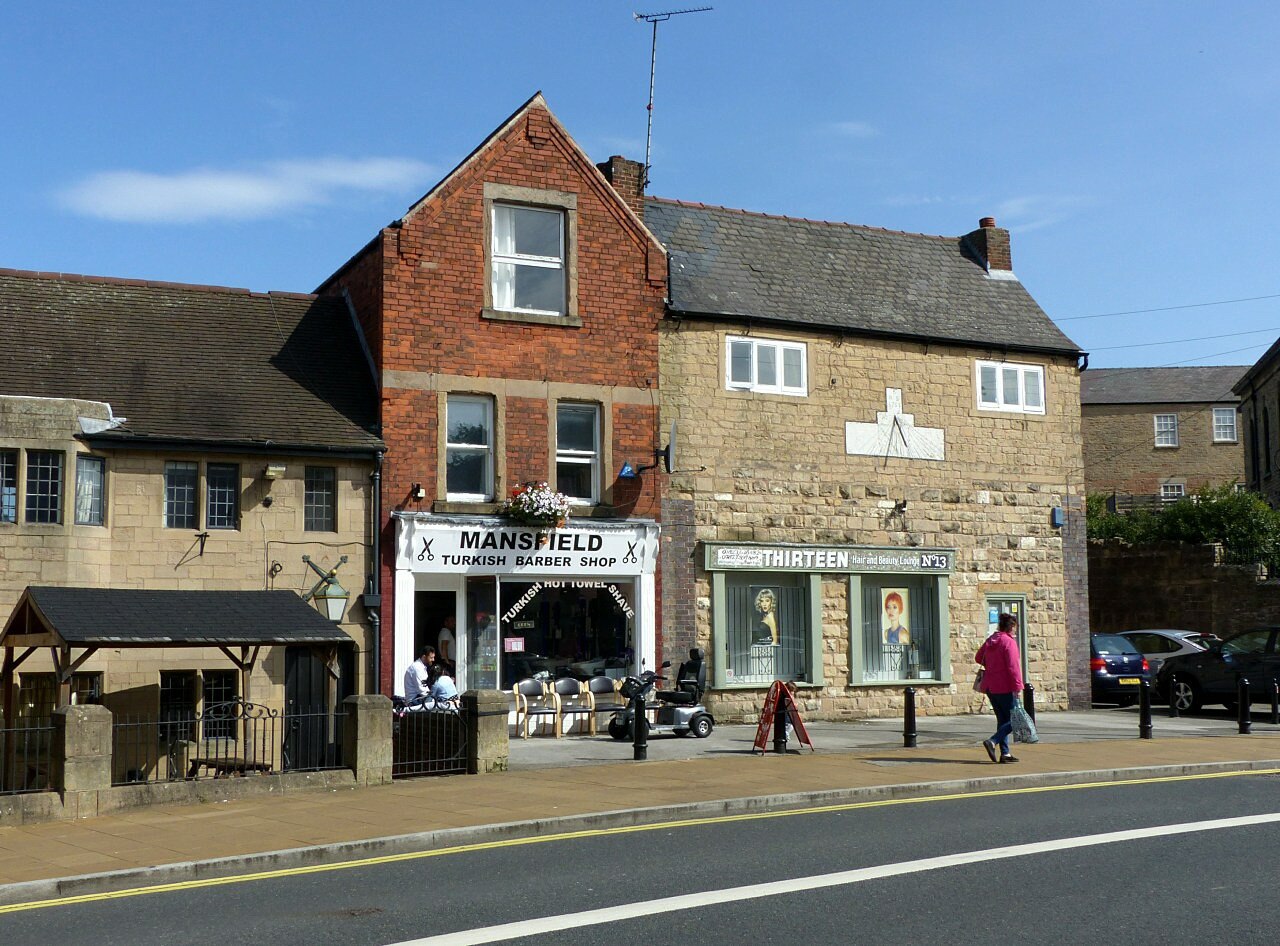
Credit: Alan Murray-Rust / ‘Thirteen’, Bridge Street, Mansfield / CC BY-SA 2.0
Most visitors to Britain will probably head straight for Buckingham Palace, the Tower of London, or Shakespeare’s Stratford. But should you wander off the tourist trail, you’ll soon notice a curious abundance of Turkish barbershops. It might seem strange enough that these hairdressers are literally everywhere. Stranger still is that there’s rarely anyone in any of them who is actually having their hair cut.
There are at least 13 Turkish-style barbers on a one-mile length of Streatham High Road in south London. Along Kingsland Road in Dalston, east London, there are over 16. All of them offer similar services: sharp haircuts, skin fades, wet shaves with a straight-razor and hot towel, and ear- and nose-waxing—and at tantalizingly cheap prices. None of this, it seems, is of much interest to passing customers.
If this were a phenomenon confined to London, it would hardly be worth commenting on. But Turkish barbers are proliferating well beyond the capital, across the length and breadth of the UK. You’ll see them in plush market towns, fading former coal-mining villages, out-of-town shopping parades. Settlements that would struggle to sustain a few pubs and grocery stores have all got a Turkish barber. Porth, a town in south Wales with a population of fewer than 6,000, is now home to 14 barbershops, many of them Turkish-style. That’s one for every 426 residents.
There has been a 50 percent climb in the number of barbershops in the UK since 2018, and I dare say this has nothing to do with men taking better care of themselves. (Meanwhile, women’s hair salons have actually been in decline.) Pity the fool who actually pays a fiver or a tenner in exchange for a haircut. A former intern of mine, new to the UK, will never make that mistake again. The best-case scenario is that your new hairstyle will draw widespread mockery. Unluckier clients have caught ringworm, as the untrained “stylists” tend not to sterilize their tools between jobs. TikTok is ablaze with videos of angry Gen Z-ers with messed-up hairlines, saying they’ve been ‘done dirty’ and are now ‘cooked’, courtesy of their local Turkish barber.
It doesn’t take an MI5 intelligence officer to work out what is really going on here. Many of these Turkish-style barbers are money-laundering fronts for gangs, usually involved in drugs or human trafficking. In this sense, the “Turkish” moniker is unfair. The fronts are more likely to be operated by Albanians (the undisputed kingpins of Britain’s drug trade), Iraqi Kurds, or Iranians. Some of these ‘businesses’ report takings of £100,000 to £150,000 per month—even those outside of London and on streets with multiple “competitors.”
There’s no doubt that the public feels unsettled by all this. For many parts of the UK, it is the clearest sign they have that the nation they grew up in has changed irrevocably—and one of the clearest manifestations of the rapid, seismic changes in Britain that have elevated the Reform Party to lead the national polls. The illegal boats in the English Channel they read about in the papers, or the urban crime waves they see on the nightly news, have spread out of the cities and now touch their lives directly. The tentacles of organized crime have stretched into places that, even if not well-to-do, at least had a certain innocence. And you would have to be spectacularly unobservant not to notice all this change.
For many, the Turkish barber phenomenon is an embodiment of “broken Britain.” It speaks not only to demographic change and crime, but also to a stagnating economy and to an unresponsive government.
Thanks to Britain’s economic decay, especially outside of London, would-be tenants have access to vast numbers of empty locations and boarded-up storefronts. These can then be snapped up easily and cheaply. And while regular, honest businesses may be buckling, the black markets in illicit substances and labor are positively booming.
Indeed, once a gang has acquired a money-laundering storefront, they will put the illegal migrants to work, either in the fake barbershops, usually just to stand around and look busy, or to push drugs—often, it has to be said, just as ineffectively as they cut hair. In one infamous case, an illiterate Iraqi former goat herder was caught selling cocaine in the small Welsh seaside town of Aberystwyth (population: 14,000). The man could barely speak English and was so illiterate that he needed his own name tattooed on his arm. He was arrested within five days of arriving in the town. The gang that trafficked him to Britain used barbershops and car washes as fronts.
But drug dealing and trafficking are arguably the least of it. The owner of Boss Crew Barbers in Hammersmith in west London was convicted in 2022 of funding ISIS terrorists. To add the icing on the cake, he had claimed government grants for his store being closed during the Covid-19 pandemic.
Although the public has long smelled a rat when it comes to Turkish barbers, the authorities have been slow to respond at scale, beyond investigating individual fronts or gangs. It’s not hard to conclude that, as with the now internationally notorious “grooming gangs” scandal, political correctness has played a role in this paralysis. No officer who wants to keep his career wants to be the one to suggest interrogating hard-working and enterprising migrants. Police chiefs insist it is far too “complex” to nail these criminal enterprises, even those that are operating in plain sight. But reality can only be ignored for so long.
The National Crime Agency (the closest thing the UK has to the FBI) finally began large-scale investigations into the barbershop phenomenon in early 2025. By the autumn, “Operation Machinize” had led to more than 900 arrests and around £10.7 million of suspected criminal proceeds seized. This was barely enough to scratch the surface of this vast criminal underbelly that now stretches across the UK, but it was at least the first clear acknowledgement that something not only should be done, but also could be done, with enough political will there.
Yet even now that it is well established that many of these premises are fronts for organized crime, it is still uncouth in polite society to say so. Only this week, a minister in the Labour government accused Nigel Farage of dog-whistle racism for promising harsher crackdowns on Turkish barbershops. Robert Jenrick, a former Conservative shadow minister who recently defected to Farage’s Reform UK, was roundly chastised by the media last year merely for saying the proliferation of these barbershops seemed “weird.” He clearly spoke for many across the country who, if not yet full converts to Reform, are becoming Reform-curious. Much of life in Britain seems increasingly “weird,” yet no one in the political mainstream seems willing to acknowledge this.
Anyone who boards a train in the UK will have heard the same government slogan repeatedly played over the PA system: “If you see something that doesn’t look right: see it, say it, sorted.” Officially, we are supposed to tell the authorities about literally anything that arouses our suspicions. Unofficially, if that “something” involves illegal migration or some protected group, we all know we’re expected to simply keep it to ourselves. To keep calm and carry on.
The post Britain’s ‘Turkish Barber’ Phenomenon appeared first on The American Conservative.