
Congress Can End Trump’s Unconstitutional War in Iran
Legislators have the power of the purse; they should use it.
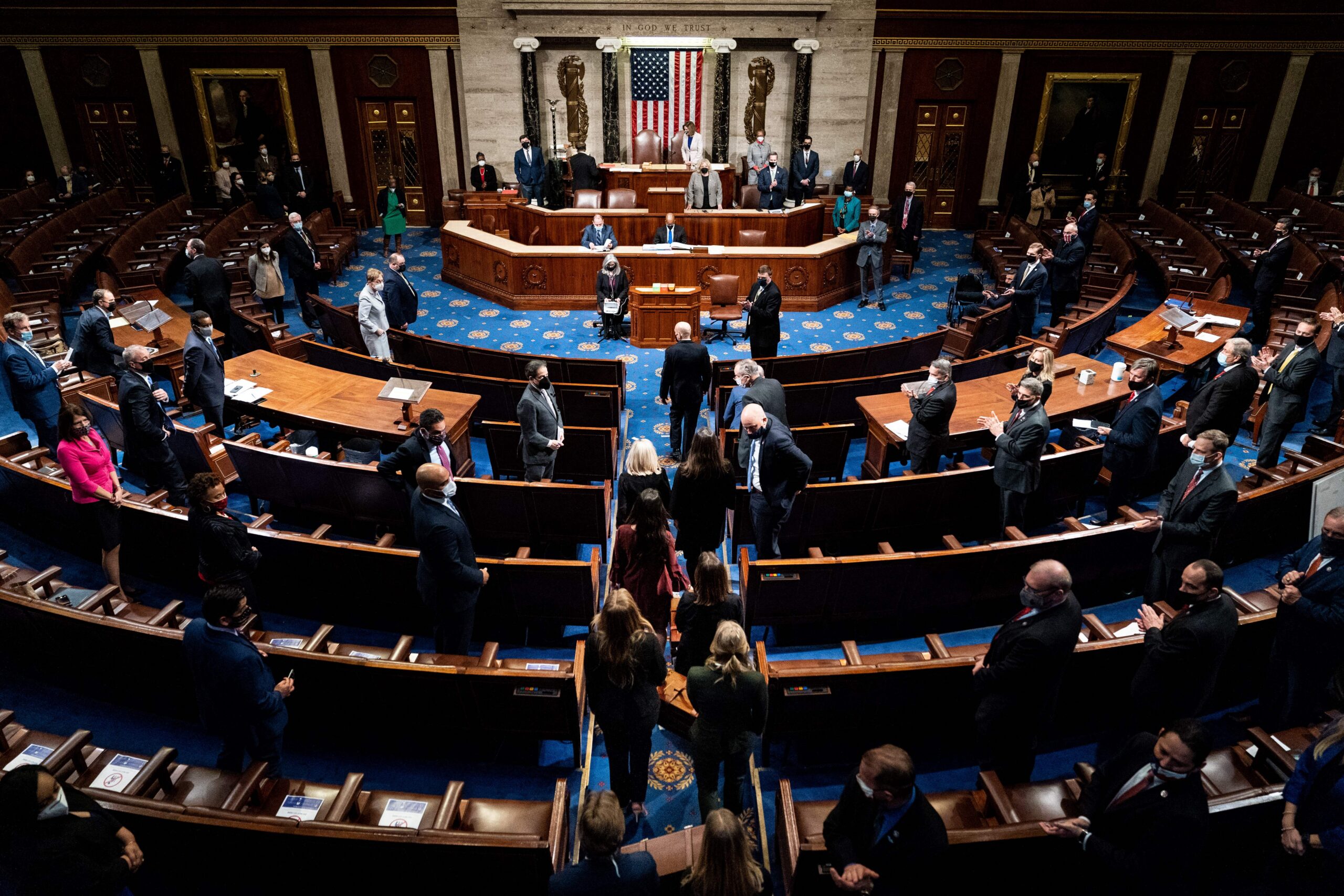
Congress can brandish the power of the purse to end President Donald Trump’s unconstitutional attack on Iran, a criminal war of aggression as defined by the postwar Nuremberg Tribunal. Congress ended the Vietnam War through the power of the purse. All Congress needs today is a fraction of the courage displayed by the 56 signatories to the American Declaration of Independence who signed their death warrants in defense of unalienable rights to life, liberty, and the pursuit of happiness 250 years ago.
The Continuing Appropriations Resolution for FY1974 (H.J. Res. 636, P.L. 93-52), signed by President Richard Nixon on July 1, 1973, prohibited expenditures to conduct combat operations “in or over or from off the shores of North Vietnam, South Vietnam, Laos or Cambodia” after August 15, 1973. That funding termination put the nail in the coffin to the gratuitous, trillion-dollar war precipitated by the Gulf of Tonkin Resolution, which was itself predicated on a lie about a second North Vietnamese torpedo attack on twin United States destroyers.
Ending the Vietnam War proved a congressional stroke of genius. Vietnam has since evolved from an enemy to an ally or semi-ally of America in containing Chinese hegemony in Asia. Among other things, Vietnam enjoys permanent normal trade relations with the United States.
The various Boland Amendments from 1982–86 were first cousins to Congress’s use of the power of the purse to arrest presidential misadventures abroad. They prohibited intelligence agencies, including the CIA and the Department of Defense, from expenditures to overthrow the Nicaraguan government. The amendments invited circumvention by limiting the spending ban to “intelligence agencies,” leaving non-intelligence agencies or foreign governments acting on behalf of the United States free from the prohibition.
The Selective Training and Service Act of 1940 is also an informative precedent. It restricted draftees to service within the Western Hemisphere, or U.S. territories or possessions.
The Constitution contemplates congressional control over spending enshrined in Article I, section 9, clause 7 as an invincible check on executive abuses. James Madsion, father of the Constitution, elaborated in Federalist 58: “This power over the purse may, in fact, be regarded as the most complete and effectual weapon with which any constitution can arm the immediate representatives of the people, for obtaining a redress of every grievance, and for carrying into effect every just and salutary measure.”
Congress should enact the following bill: “No monies of the United States may be expended to conduct combat operations against Iran without a congressional declaration of war or in self-defense in response to an Iranian invasion of the United States. Further, no member of the United States Armed Forces may be deployed to undertake combat against Iran absent a prior congressional declaration of war or in self-defense to an unprovoked actual attack on the United States.”
Suppose the president vetoes the bill. Congress is empowered to override the veto by two-thirds majorities in the House and Senate, which was done in response to President Richard Nixon’s veto of the War Powers Resolution of 1973. Moreover, Congress could also terminate the criminal war of aggression against Iran by refusing to appropriate funds for its continuance. The Pentagon has asked the White House to approve a more than $200 billion request. The president is powerless to veto congressional inaction.
The case for congressional termination is overwhelming. Section 6(a) of the Charter of the International Military Tribunal at Nuremberg criminalized wars of aggression or in violation of treaties. Twelve high ranking Nazi officials were sentenced to death for participation in the conduct of aggressive wars, including Hermann Göring, Joachim von Ribbentrop, Wilhelm Keitel, Alfred Jodl, and Alfred Rosenberg.
Trump’s war against Iran is flagrantly unconstitutional. Article I, section 8, clause 11 endows Congress with exclusive power to take the nation from a state of peace to war. Madison amplified in Helvidius 4:
In no part of the constitution is more wisdom to be found than in the clause which confides the question of war or peace to the legislature, and not to the executive department. Beside the objection to such a mixture of heterogeneous powers: the trust and the temptation would be too great for any one man…War is in fact the true nurse of executive aggrandizement. In war a physical force is to be created, and it is the executive will which is to direct it. In war the public treasures are to be unlocked, and it is the executive hand which is to dispense them. In war the honors and emoluments of office are to be multiplied; and it is the executive patronage under which they are to be enjoyed. It is in war, finally, that laurels are to be gathered, and it is the executive brow they are to encircle. The strongest passions, and most dangerous weaknesses of the human breast; ambition, avarice, vanity, the honorable or venial love of fame, are all in conspiracy against the desire and duty of peace.
Hence it has grown into an axiom that the executive is the department of power most distinguished by its propensity to war: hence it is the practice of all states, in proportion as they are free, to disarm this propensity of its influence.
Trump’s attack on Iran in partnership with Israel was not in self-defense. It is a criminal war of aggression, plain and simple, including a violation of the United Nations Charter. Iran had not invaded the United States or threatened to do so. It sported no military bases near the perimeter of the United States, in contrast to America’s military establishments among Iran’s neighbors, including Qatar, Bahrain, and Kuwait. Iran’s nuclear ambitions are dwarfed by Israel’s hundreds of nuclear warheads and the arsenal of over 5,000 possessed by America. Israel and the United States prohibit any outside inspection of their nuclear arsenals, whereas Iran permits some however imperfect. Iran’s premier atomic scientists had been assassinated. It was struggling to suppress domestic insurrection fueled by religious bigotry and a decrepit economy strangled by economic and trade sanctions.
This is not to defend Iran’s despotism. But Iran is not alone in that category. North Korea or Myanmar are worse. China’s repression of Uighurs and Tibetans is notorious. But the United States cannot alleviate oppression by wars of aggression against their oppressors. We cannot summon into being the civil society necessary for self-government and the rule of law. Our $2 trillion misadventure in Afghanistan, spanning two decades and ending with a restoration of the Taliban, is proof enough. As Secretary of State John Quincy Adams explained in a July 4, 1821 address to Congress, we wish freedom and independence well everywhere. But we resist going abroad in search of monsters to destroy. We fight only in self-defense to escape dictatorship at home.
Congress is our deliverance from the crime of aggressive war. It has declared war in only five conflicts over 237 years, and only after being convinced that an aggressor had already broken the peace: the War of 1812, the Mexican–American War, the Spanish–American War, the First World War, and the Second World War. Trump has refrained from asking Congress to declare war against Iran because he knows his request would be Dead on Arrival, just as Congress rebuffed President Barack Obama’s 2013 request for a declaration of war against Syria.
In sum, all that is necessary to end Trump’s unconstitutional and criminal war of aggression against Iran is for Congress to do its job.
The post Congress Can End Trump’s Unconstitutional War in Iran appeared first on The American Conservative.