How Greenland Could Destroy Half the World
President Donald Trump is freaking out Europe and Canada for no good reason.
The annual meeting of elites in Davos this week is shaping up to be super awkward, and for an odd reason: President Donald Trump’s got Greenland on the brain. “The World is not secure unless we have Complete and Total Control of Greenland,” Trump wrote this weekend to Norway’s prime minister.
In normal times, Americans don’t fret much about Greenland—a Danish territory and the least aptly named island on the planet—and American presidents don’t declare they must seize it to save the world.
But these are not normal times.
Due to global warming, ice in Greenland and the Arctic broadly is melting fast, and new shipping routes are opening. In our age of “multipolarity,” that means the far north is becoming a theater for great power competition. Look at a globe, not a 2D map: The Russians are closer than you might think.
Even in eras past, Washington coveted the island’s geostrategic location, humongous size, and suspected wealth of natural resources. The administrations of Presidents Andrew Johnson and Harry Truman tried to buy it, as did Trump in his first term. But in the 19th and 20th centuries, as now, Copenhagen wasn’t looking to sell.
Unlike those other presidents, however, Trump has pressed on. This weekend he threatened to slap 10 percent tariffs on Denmark and seven other European nations that oppose a U.S. takeover of Greenland, and he said the rate would rise to 25 percent until a deal is reached. That’s a shakedown, not a negotiation. And Trump hasn’t ruled out military force. Last week he warned that, if Denmark doesn’t give up Greenland “the easy way,” then the U.S. will take it “the hard way.”
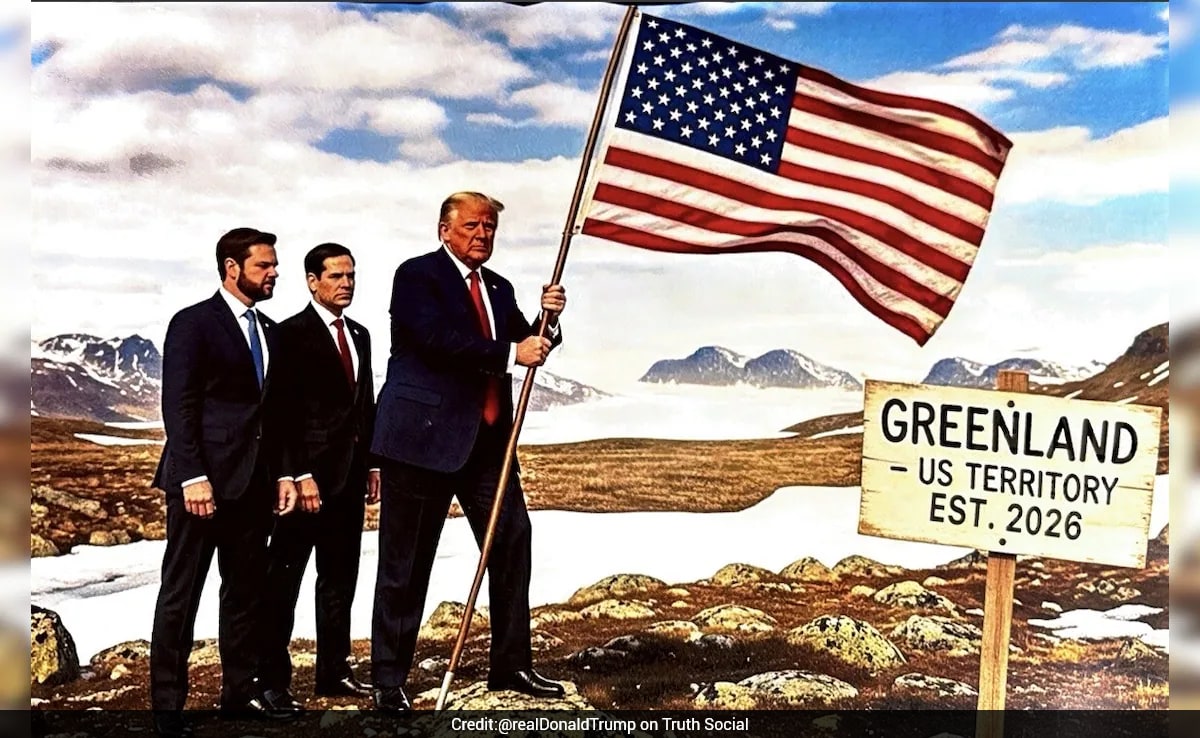
The president’s imperial appetite has grown since the successful capture of Venezuela’s then-president Nicolas Maduro three weeks ago. On Tuesday, Trump posted a doctored image on social media that showed him presenting to European leaders a map of an enlarged America that included Venezuela, Greenland, and Canada.
Trump’s unorthodox, brash approach to international politics has yielded more benefits than his critics acknowledge, as I laid out in my column last week. But on Greenland (and Canada), he’s making a huge mistake, perhaps the biggest of his political career.
The upsides of acquiring the world’s largest island are smaller than they appear, while potential downsides are catastrophic if Trump seizes it by force or strong-arms Denmark into relinquishing it. Most notably, a divorce between America and Europe looks more and more likely, as European capitals start viewing Washington, its historic ally, as an expansionist enemy.
Despite what Trump says, “total control” isn’t required to bolster Greenland’s defenses. Washington already has a security pact with Copenhagen, one of its most pliant allies, that lets it establish an extensive military presence across the island. At present, the U.S. doesn’t take advantage of that lopsided 1951 agreement, maintaining only one military installation on the territory.
Moreover, the U.S. needn’t take the lead in fortifying Greenland. Five other NATO countries also hold significant territory lying within the Arctic Circle: Canada, Norway, Sweden, Finland, and Denmark itself. Why not work with them, rather than taking yet another security burden onto America’s shoulders? Call the group “the Arctic Six” and nudge its non-U.S. members to boost their commitments.
Trump has said that Russia and China pose a threat to Greenland, but experts deny his claim that military vessels from those countries surround the island. The White House should heed the risks of self-fulfilling prophecy: As with Ukraine before Russia invaded it, efforts to militarize Greenland could backfire by prompting Moscow to overreact.
Some supporters of Trump’s push for Greenland warn that its indigenous Eskimos might declare independence from Denmark and join up with China. But the Arctic Six can cross that hypothetical bridge—together—if they come to it. And Trump’s current approach is making an anti-Western independence movement in Greenland more likely. If Trump does acquire the island, Washington will be responsible for tens of thousands of frightened, anti-American foreigners in the Arctic.
And that might be the least of the downsides. For not just Greenlanders, but also Canadians and Europeans, are freaking out, even as they’ve managed to keep cool in public. They’re accelerating efforts to hedge between China and the U.S. and derisk from the latter—precisely the opposite of what America should want. Analysts judge that NATO is approaching collapse.
We’ve even begun to imagine a U.S.–European war.
After Trump started escalating threats last week, eight European nations deployed a small number of troops to Greenland. Officially, the troops were on a routine training mission, but that struck both Trump and international media as a pretext. In truth, they served as a tripwire force to demonstrate Europe’s resolve and make Trump think twice about invading. That the Europeans stationed troops on Danish territory to deter U.S. aggression marks a disturbing transformation of world affairs.
These were the eight European nations on which Trump, afterwards, imposed punitive tariffs. Fortunately, the escalation spiral seems to have mostly ended there, notwithstanding Trump’s continued rhetorical hostility. Germany withdrew its forces, and European leaders talked about a “misunderstanding.” Still, Denmark on Monday sent more troops to Greenland.
Of course, the Europeans don’t want a shooting war with America, but they are warming to the possibility of an economic one. Since the much-ballyhooed critical minerals of Greenland are difficult to extract, the potential economic costs of alienating Europe aren’t worth the candle. And the Europeans really could burn America.
“For all its military and economic strength, the U.S. has one key weakness: it relies on others to pay its bills via large external deficits,” a senior researcher at Deutsche Bank told Bloomberg. “In an environment where the geoeconomic stability of the Western alliance is being disrupted existentially, it is not clear why Europeans would be as willing to play this part.”
It’s also unclear why the Americans would threaten the stability of the Western alliance. While the White House has pushed Europe to shoulder more of the burden of its security, it’s also promoted a civilizational view of Europe as the wellspring of America’s cultural inheritance. Vice President J.D. Vance has been the administration’s most eloquent spokesman for this nuanced perspective.
He’s in good company. America’s sharpest paleoconservative nationalists—Sam Francis, Joseph Sobran, and Pat Buchanan—were staunch Western civilizationists. They put America first, but they understood that America was, in essence, a European nation. And after the Cold War, they acknowledged that Russia was too.
The White House should learn from them and look for opportunities to unite the Global North. Greenland looks symbolic from this point of view, situated as it is between the three pillars of Greater Europe: Russia, North America, and Europe proper. Leaders from these regions can either watch their shared civilization perish or collectively take on the existential challenges of mass migration, anti-white ideologies, and low fertility rates.
In a more enlightened world, the Northmen might meet once a year in Greenland, not Davos, to address Russian–Western tensions and discuss their common European future. Instead, the frozen island could become the iceberg upon which the West founders and sinks.
The post How Greenland Could Destroy Half the World appeared first on The American Conservative.