Marco Rubio’s “Democratic Hemisphere” vs. the National Security Strategy
In Latin America, the White House abandons its own strategic doctrine for democracy promotion.
Earlier this month, Daniel Ortega, the dictator of Nicaragua, announced that his country would no longer hold elections. In response, Secretary of State Marco Rubio issued a statement condemning Ortega and declaring that Nicaragua “cannot expect to maintain business as usual with other nations when it is thwarting the basic tenets of our democratic hemisphere.”
There is no doubt that Nicaragua has suffered under the rule of Ortega and his wife Rosario Murillo, who have run the country as their personal fiefdom for nearly two decades. But Rubio’s rhetoric on Latin America increasingly resembles the neoconservatism President Trump was ostensibly elected to displace.
In last year’s National Security Strategy (NSS), the Trump administration declared that it would “be realistic about what is possible and desirable to seek in its dealings with other nations.” The document also said the United States would pursue “good relations and peaceful commercial relations with the nations of the world without imposing on them democratic or other social change that differs widely from their traditions and histories.”
Although a departure from the stated approach of the Biden White House, this is less revolutionary than many people would suppose: Ever since the United States stepped out onto the world stage, it has always and of necessity been connected to governments of varying moral and political character. During the Second World War, we famously saved Stalin’s USSR from collapse to win the war against Hitler; today, we work hand in glove with Saudi Arabia, an authoritarian dictatorship with a bad habit of dismembering journalists that also happens to be the keystone of our Middle East strategy.
The reasons for this are simple: foreign policy is about furthering American interests, which often requires working with countries that are very different from our own. As the NSS states, “We recognize and affirm that there is nothing inconsistent or hypocritical in acting according to such a realistic assessment or in maintaining good relations with countries whose governing systems and societies differ from ours even as we push like-minded friends to uphold our shared norms, furthering our interests as we do so.”
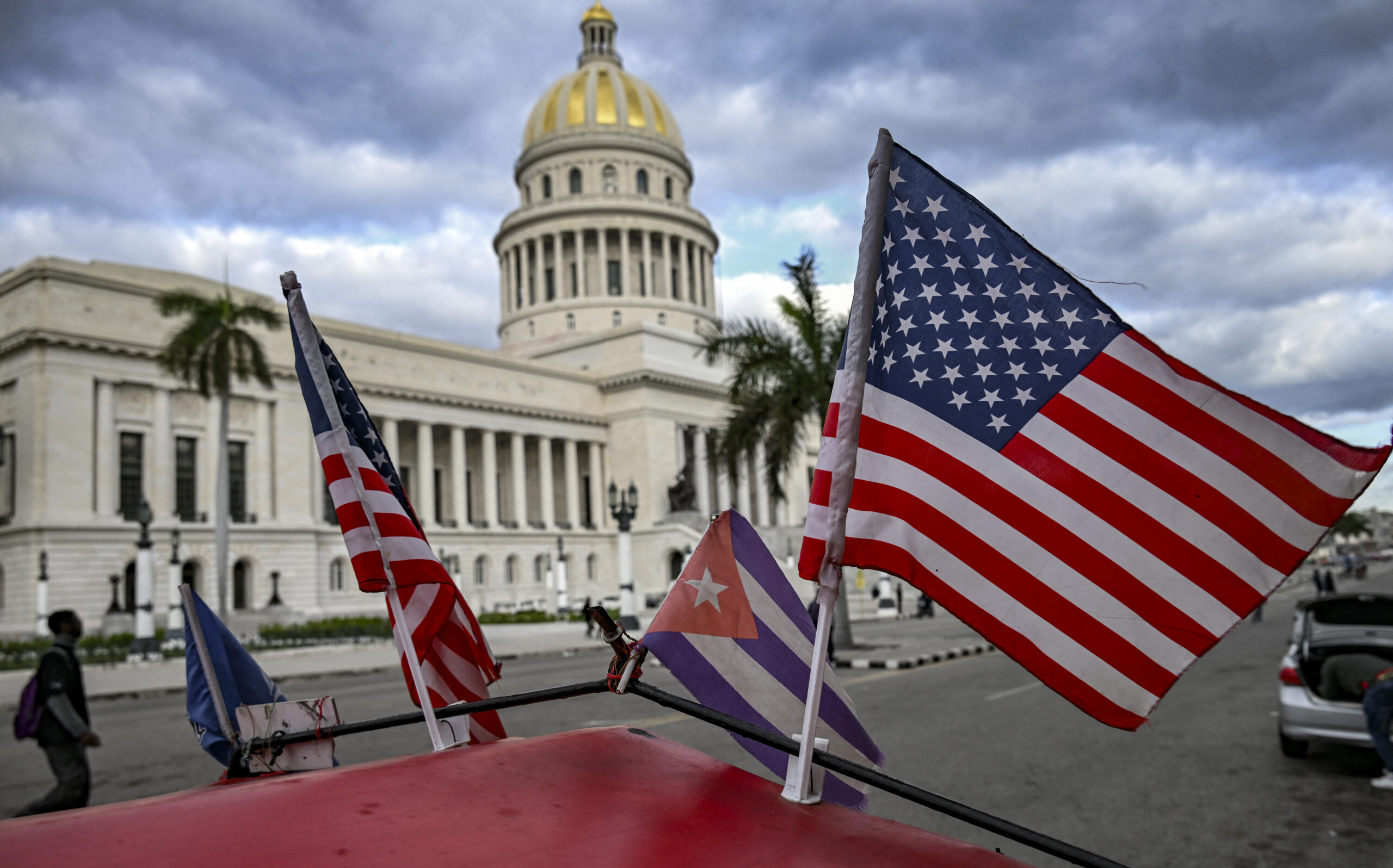
Unfortunately, the White House appears to have tossed this wisdom aside in the Western Hemisphere. Instead, we are being treated to reheated platitudes about battling communism and spreading democracy abroad. The State Department recently released a 100-page document entitled “Cuba: The Capital of 21st Century Communism,” which, despite its name, consists almost entirely of the rehashing of Cold War–era grievances.
The document is a transparent and clumsy effort to gin up support for intervention against Havana, which has not been a serious threat to American interests since the demise of the Soviet Union. Indeed, the biggest challenge Cuba presents to the U.S. is its potential collapse—which we seem to be doing our best to precipitate via a tightening oil embargo on the island—as that could trigger a massive migration crisis.
The White House has been alarmingly consistent in its assertions that it is preparing for aggressive action in Cuba. In February, still riding the high of his apparently clean decapitation of the Maduro regime in Venezuela, Trump touted the potential for a similar outcome in the Caribbean: “The Cuban government is talking with us,” he told reporters. “We could very well end up having a friendly takeover of Cuba.”
The talks don’t seem to have panned out, however, and U.S. rhetoric has escalated since then. “I think I can do anything I want with [Cuba],” Trump said on March 16. The next day, he laid out his timetable: “We’re talking to Cuba,” the president stated, “but we’re going to do Iran before Cuba.”
There is, at present, little prospect of a quick resolution to the war in Iran, but the Trump administration has continued to ramp up for intervention in Latin America. In late May, the Department of Justice indicted Raul Castro, the former president of Cuba and the brother of the late Fidel Castro, for his role in the 1996 shootdown of two planes flown by Cuban exiles. (It has been widely speculated that the indictment was drawn up to justify something similar to January’s Venezuela operation.)
More concerning still, CBS News reported earlier this month that the Pentagon is drawing up plans for military action in Cuba, including “an Army-led air assault involving thousands of U.S. soldiers to be carried out by the 101st Airborne Division.”
The second Trump administration’s renewed focus on the Western Hemisphere has been, in many ways, a long-overdue development. This is the region most intimately bound up with the real interests of the United States. Combating drug trafficking, illegal immigration, and possible adversary influence over our near abroad are important foreign policy goals. But crude reversion to a Cold War-era framing is the wrong way forward.
The administration would be better served by holding to its own National Security Strategy, which recommends the application of American economic power to secure concessions from uncooperative regimes, rather than the open pursuit of regime change—a tactic which has consistently failed to produce good results.
The post Marco Rubio’s “Democratic Hemisphere” vs. the National Security Strategy appeared first on The American Conservative.