
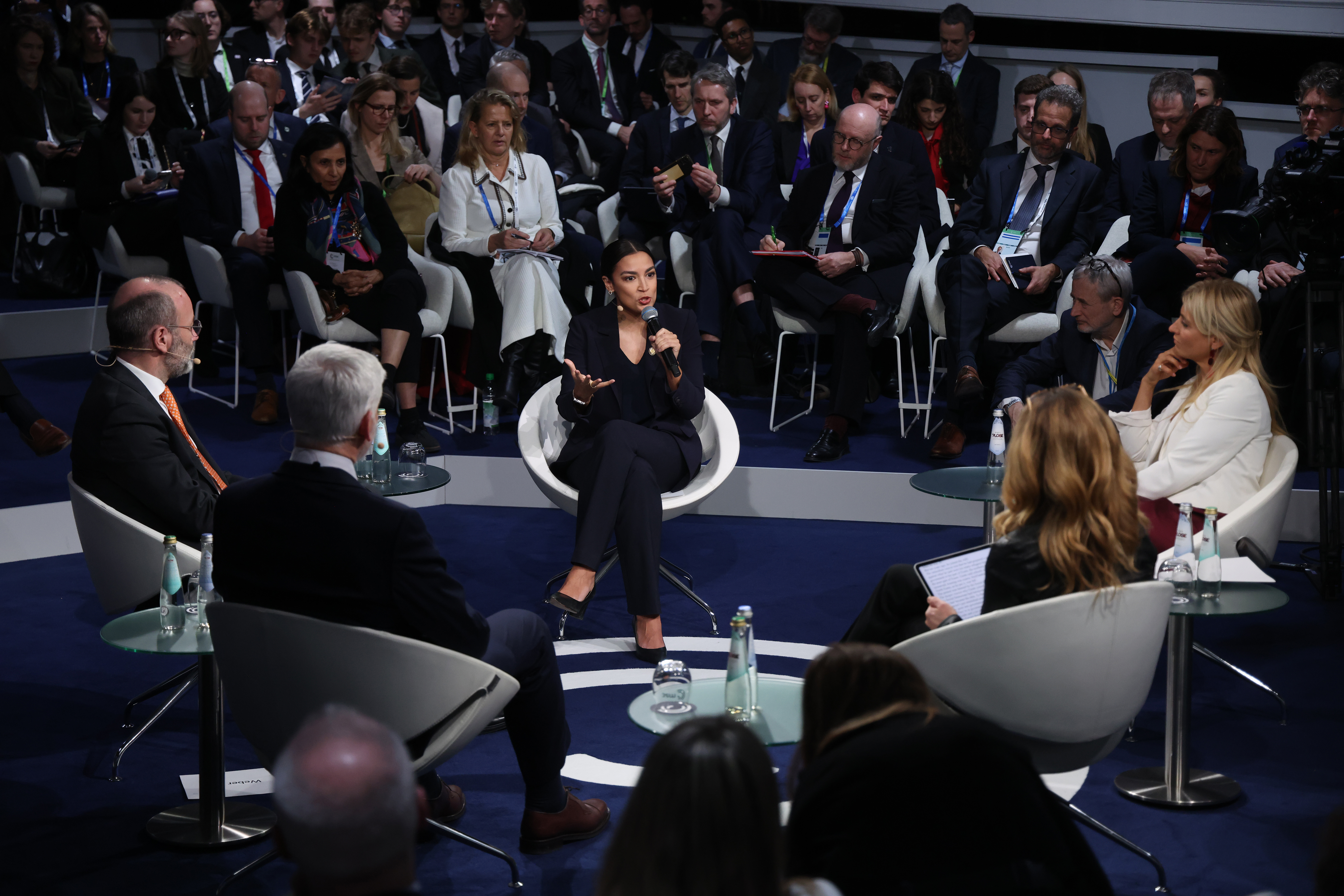
Alexandria Ocasio-Cortez went to the Munich Security Conference to introduce herself to the world as a foreign policy thinker. She returned having demonstrated something else entirely: that the Democratic Party’s progressive star has absorbed the establishment’s worst ideas while shedding only its least popular rhetoric.
To be fair to AOC, some credit is due. On Gaza, she said something obvious: Unconditional American aid to Israel enabled massive civilian death. She even referred to Israel’s actions in Gaza as “genocide.”
Further, echoing the Canadian Prime Minister Mark Carney’s Davos speech, she expressed skepticism about the “rules-based order” fiction. “The rules for whom?” she rightly asked, pointing to the obvious hypocrisy of those “rules” being broken at will by those who have enough power to do so without consequence.
The attacks came immediately, and they were predictable. Democratic Sen. John Fetterman (D-PA), who has made Israel’s defense his signature issue, called AOC’s alignment with pro-Palestinian voices “a rot in my party.” Fox News ran segments on her “shocking ignorance.” Mark Dubowitz of the Foundation for Defense of Democracies, a neoconservative hawk, dismissed her as a “media-driven celebrity” whose comments “expose shallow and deeply flawed thinking.”
But here’s the thing: When Fetterman, Dubowitz, and Fox all attack you, you might actually be onto something. These are not good-faith critics. They are the foreign policy establishment’s attack dogs, and their howling is not a sign of error—it is a sign that AOC touched a nerve. In a party whose senior leadership still largely gives Israel the benefit of the doubt, AOC deserves credit for speaking plainly.
But courage in speech is not courage in action. And here the credit ends. Months before she flew to Munich to condemn Israel’s assault on Gaza, AOC had a vote to do something about it. When then-Rep. Marjorie Taylor Greene (R-GA) offered an amendment to cut $500 million in funding for Israel’s Iron Dome system, AOC voted no. She was one of 422 members who kept the money flowing.
AOC argued the amendment targeted defensive systems, not “offensive aid” or U.S. munitions being used in Gaza. She remained, she insisted, “focused on cutting the flow of U.S. munitions that are being used to perpetuate the genocide.” What she didn’t consider, though many commentators pointed it out, is that Israel’s sky shield allows it to act aggressively in its region without fear of retaliation.
This is the AOC paradox: She wants credit for opposing U.S.-enabled Israeli militarism without accepting the political cost of actually opposing it.
Rep. Thomas Massie (R-KY), a libertarian who needs nothing from the activist left and faces primary pressure not from Gaza protesters but from the Israel lobby, simply voted yes on the cut. He does not speak of genocide. He does not weep on the House floor. But when the question is whether American dollars will flow to that conflict, his hand moves in a way that AOC’s does not.
On Russia and Ukraine, the pattern repeats—though here AOC does not even offer the courage of speech. She simply recites the establishment catechism.
“There’s no conversation about Ukraine that can happen without Ukraine,” she told reporters in Munich, “and so they, of course, lead in terms of setting their terms.” This is both true and meaningless. Every diplomat on earth agrees Ukraine must be at the table. The question is what happens when Ukraine’s terms diverge from the reality on the ground, and what the American interest in this is.
One would assume, as indeed the White House’s new National Security Strategy (NSS) does, that the primary interest of the United States is to avoid a catastrophic, potentially nuclear, war with Russia. The NSS sensibly emphasizes that “strategic stability” with Russia as a core U.S. interest. By contrast, AOC’s comments are simplistic:
[BLOCK]Overall, as a principle, we shouldn’t reward imperialism, and I don’t think that we should allow Russia to continue or any nation to continue violating a nation’s sovereignty and to continue to be rewarded and whose main lesson and takeaway is that they will gain.[/BLOCK]
Again, unobjectionable as sentiment. But then: “And so what that looks like in the specifics, I think is a deeper conversation.”
But the “deeper conversation” is the one that really matters. What are the territorial trade-offs to shut the war in Ukraine down and prevent its spillover to the EU and NATO? What security guarantees for Ukraine can actually be enforced? What does “not rewarding imperialism” mean when Russia already occupies around 20 percent of Ukraine and shows no sign of withdrawing? What happens when Ukraine’s stated war aims—a return to 1991 borders, reparations, war crimes tribunals—are simply not achievable by means America is willing to deploy in an arena of no vital U.S. security concern?
These are not abstractions. They are the brutal choices that any serious foreign policy thinker must confront. AOC retreats from them into principle. But principle without policy is simply posture.
And the framework she retreats into—“democracy versus autocracy,” the struggle between “freedom-loving nations” and “authoritarian revisionists”—is the same binary worldview that neoconservative hawks like Robert Kagan have spent decades peddling and that the Biden White House made its rhetorical signature. Such thinking has justified every catastrophic intervention from the Balkans to Iraq to Libya and now inspires much of the loose talk of regime change in Iran. It is the language of moral crusade, not statecraft.
So, the irony is that the Fettermans, Dubowitzes, and Fox News commentators have it exactly backwards. They attacked AOC for her Gaza comments as if she were some kind of a radical on foreign policy. In truth, on the question that matters most—American grand strategy—she is utterly conventional.
She did not use her Munich trip to discuss with her hosts why American troops should remain in Europe 80 years after the end of World War II. She did not wonder how to bring the war in Ukraine to an end and what useful role Europeans could play in that. She reaches, reflexively, for the democracy-versus-autocracy framing that has justified every foreign policy disaster of the last 30 years.
Perhaps the most revealing inconsistency in AOC’s worldview was exposed in her rhetoric on the “foreign policy for the working class.” If she truly wanted foreign policy to center working-class people, she would wonder whether the entire edifice of global military entanglement—which she implicitly endorsed with her rhetoric against “withdrawing from the world”—might itself be a mechanism for extracting wealth and blood from the same working class she claims to champion.
She does not ask these questions. She cannot, because asking them would require abandoning the very framework she has just endorsed.
The real dissenters on foreign policy today are not on the progressive left. They are in the Thomas Massie/Rand Paul/Marjorie Taylor Greene/Tucker Carlson wing of the Republican Party—the intellectual heirs of Ron Paul and Pat Buchanan. On the question of American empire, they have been more clear-eyed than nearly any Democrat of stature. They are skeptical of the interventionist framing that AOC, despite some misgivings, ultimately endorses.
The post On Foreign Policy, AOC Is Just More of the Same appeared first on The American Conservative.