
The Little Auteurist
From an early age, I’ve interpreted movies as mysterious manifestations of one person’s consciousness.
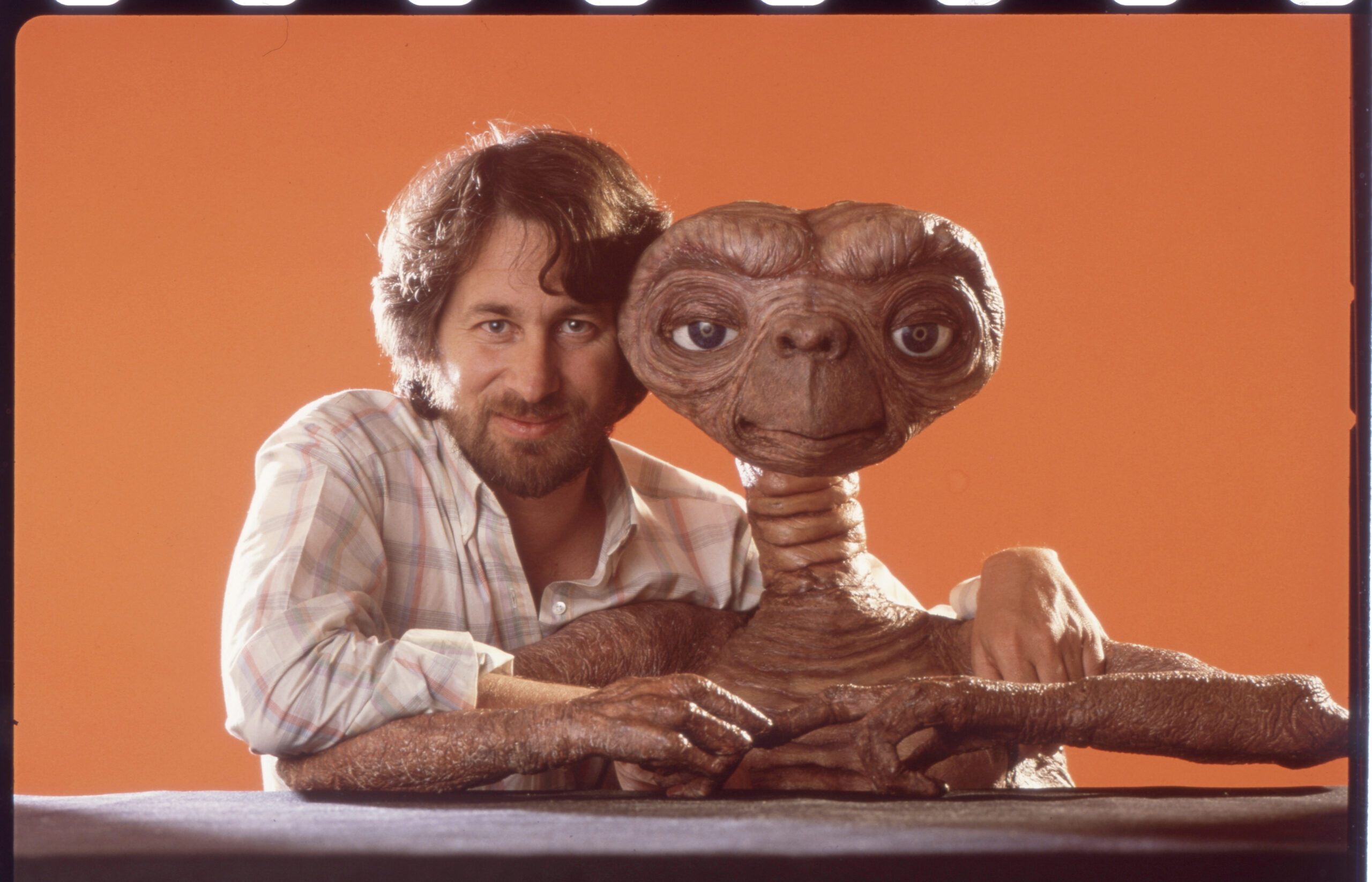
Dear readers of TAC: Does anyone else remember the VHS cassette tape of E.T. the Extra-Terrestrial that was accented with a horizontal green strip across its top?
That I can distinctly recall it confirms both my aged status as a child of the Reagan era—some Googling reveals that the E.T. tape in question seems to have been released in October 1988, when I would have been five years old—and, more significantly, the decades-long presence in my imagination of the movie’s director, Steven Spielberg.
I do not intend to present myself as a prodigy, but I can say with some certainty that I would have known, even as a lad, the name “Steven Spielberg.” I am guessing I had turned six when I saw E.T., and by then, I absolutely understood the opening credits in a movie as consisting of the names of the people who made the movie. I am equally confident that I grasped, even then, that one man in particular—the fellow whose name fell beneath the words “Directed By”—had the most to do with that making. Could I comprehend the particulars of what a director did? Of course not. But I did know that movies were not real life, that someone had to make them. Otherwise, how would I have known that I wanted to make them myself?
That I would have had an awareness, even a vague one, of Steven Spielberg at that age is really not so surprising. I certainly would have been able to identify the authors or illustrators of favorite children’s books. And before doubting my whiz kid status, do not discount the fact that I had a movie-mad mother who oversaw my early cinematic education. This is the mother who made her well-worn VHS tape of Alfred Hitchcock’s North by Northwest a staple of my early childhood viewing, thus assuring my near-lifelong familiarity with the perils of Mount Rushmore and the music of Bernard Herrmann (whom I would not have been able to name but whose opening theme to North by Northwest is imprinted on my mind).
What is my point in this reminiscence? Well, I was thinking about that tape of E.T. with the release this weekend of Spielberg’s new alien epic, Disclosure Day. But my early identification of E.T. with its director anticipated my eventual vocation of film critic and the critical school to which I have stubbornly aligned myself since adolescence, auteurism—which nominates the director as the figure whose vision permeates a movie. I was a teenager when I began reading the expositors of auteurism—Andrew Sarris and Francois Truffaut and the like—but I was prepared, subconsciously, for their arguments because of my youthful viewing of the collected works of Steven Spielberg.
In the years after I first saw E.T., I absolutely understood his other films to be his other films: Raiders of the Lost Ark, Jaws, Indiana Jones and the Temple of Doom—these were Spielberg productions. I was eight when I rented Close Encounters of the Third Kind, and I distinctly recall comparing and contrasting it with E.T.: themes and variations on interstellar travel. And I was probably nine when I went to the library to check out a book about Spielberg’s movies, which must have given me my first glimpses of such lesser known Spielberg films as Duel and The Sugarland Express and 1941. But having already purchased a copy of the book The Art of Alfred Hitchcock—see, my mother’s influence proved lasting—I was familiar with the concept of books that offered descriptions of, and (tantalizingly) stills from, a director’s various movies. And it seemed utterly logical to me to organize any set of movies according to their director. I may not have known of any directors besides Spielberg or Hitchcock or possibly Ron Howard (because, when not making movies, he was on reruns on TV), but what can I say? It was a start.
In fact, I am thoroughly persuaded that the way I came to experience movies proves how intuitive auteurism is. To understand movies as “collaborations,” as the cliché goes, requires a great deal more brain power than to perceive them as mysterious manifestations of one person’s consciousness. Growing up, I did not know how Hitchcock made Psycho Hitchcockian—I just knew that it was. This remains my credo as I search, as a working film critic, for signs of authorial presence in films by the likes of W.S. Van Dyke, Gordon Douglas, and, in these very pages, Richard Fleischer.
You might say I never grew up. Or you could also say I grew up very, very quickly. I was an auteurist at six.
The post The Little Auteurist appeared first on The American Conservative.