
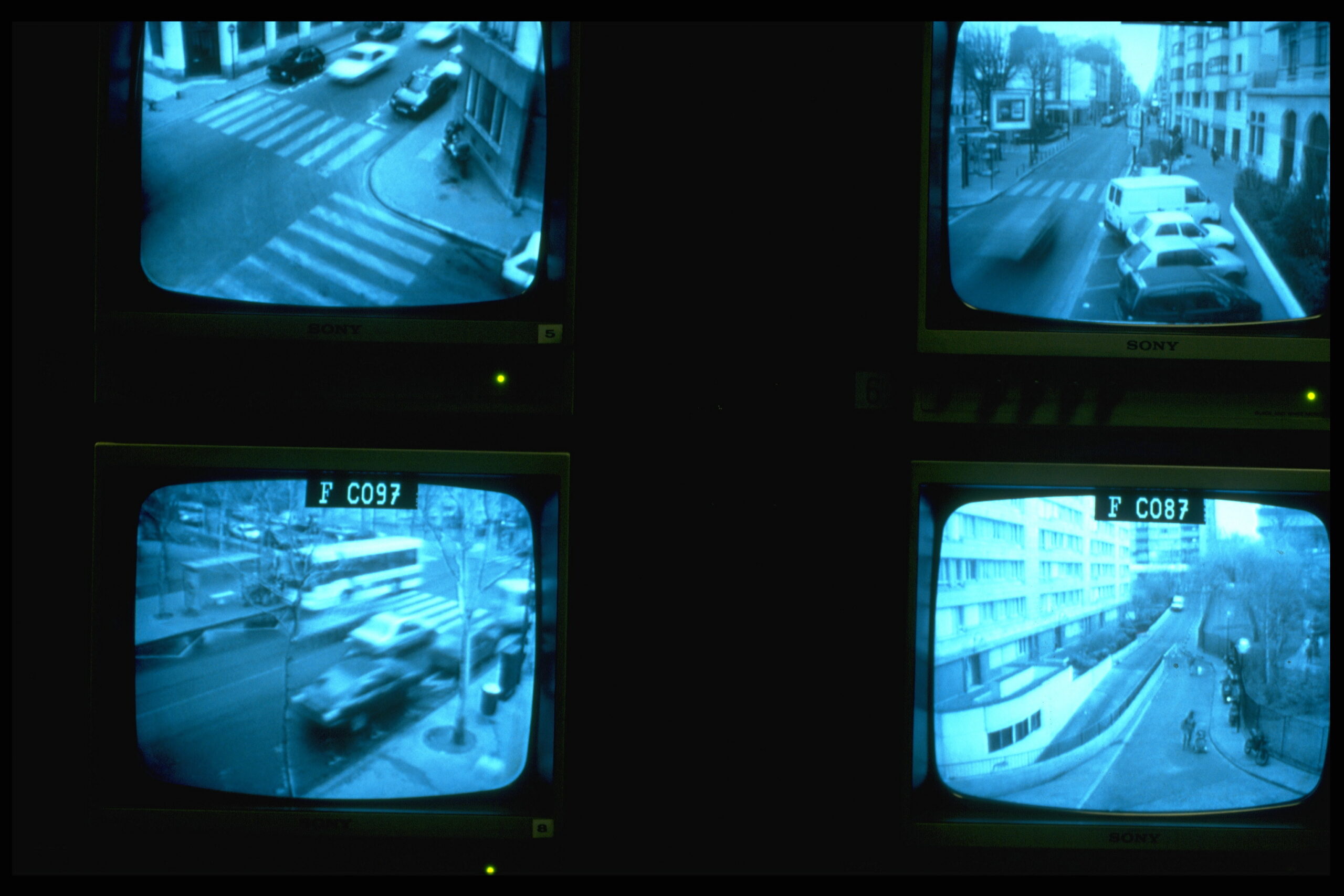
We are being watched all the time: they are spying on us.
I am old enough to think that being watched entails men in raincoats hanging about in the shadows cast by a lamppost on the opposite side of the street from your house. And it really was a little like that. During my childhood in England, divorce wasn’t easy and cause had to be provided. Probably the most common cause was adultery, which had to be proved rather than merely alleged. This was the bread and butter of the private detectives of the time. After my mother died, I found the private detective’s report on my father, dated in the mid-1950s when she thought of divorcing him. (She didn’t divorce him in the end, though not because of negative reports, instead settling for mere separation.)
Private detection and spying on people was only a cottage industry by comparison with what it is today, when everything happens, if not in the glare of publicity exactly, at least within the purview of electronic surveillance of one kind or another. Surveillance is to us what electricity was to James Thurber’s aunt, that is to say leaking all over the house.
I first realised the ubiquity of video surveillance in modern life when I gave evidence in murder trials. Murderers, it seemed, were videoed from the moment they left their front door until well after the time they left the location of their murder. The quality of the film in what now seem to me like the old days was very poor, so that it was actually quite difficult, for me at least, to recognize the protagonist of the surveillance videos, but their quality improved so that they became unmistakable.
It took me a little while to realize that there was nothing special about the surveillance of murderers: it was just that the film of them became of interest ex post facto. It wasn’t that a camera was trained on them from the moment they left their front door because someone knew that they were going to commit a murder that day (in which case, why would no one have prevented it?). We are all stars of videoed performances, all the time.
I realised the creepy power of electronic tracing in a curious way—and this was already quite a number of years ago. I was writing a short essay on Ibsen’s play, Ghosts, which oddly enough was first performed (in Danish) in Chicago, for a medical journal. The plot of the play requires that syphilis be transferable to a son via the father alone, and also that the first manifestation of congenital syphilis be the mental changes of General Paralysis of the Insane, that is to say a form of tertiary syphilis. I wanted to know whether Ibsen’s plot was plausible or even possible, but present-day venereologists were not able to answer because congenital and tertiary syphilis are now so rare that they did not know.
It was then that I turned for an answer to the great French syphilologist of the later 19th century. Alfred Fournier (Professor Tallis, a very witty man, said he should have been called Forniquer), who wrote a book of the title La Syphilis héréditaire tardive (“Late Hereditary Syphilis”). It turned out, when I read it, that Ibsen was right—he kept up to date with the medical research of his day.
But what I here want to say is that, living as I did far from any large library (and it would have to have been very large to have Fournier’s book), and the book not yet having been digitized, I wanted to buy a copy. I found three copies for sale on the internet, but they were twice as much as I would earn from my article.
Then, for the very first time in my life, I turned to eBay. I went to the section of antiquarian books and there, the first book that I found, without having asked for it, was Fournier’s La Syphilis héréditaire tardive. It was going for $8 and moreover was dedicated by the great man himself. (He was a great man). Reader, I bought it.
For a long time afterwards, I thought what an amazing coincidence this was. I was astonishingly naïve. My view of coincidence is that, in a lifetime, there are so many events that it would be surprising if there were no coincidences in it, and therefore I was somewhat contemptuous of people who saw deep significance in a coincidence, however unlikely that coincidence might seem. For, as I have said, a whole lifetime without an unlikely coincidence would be unlikely.
But just because people who believe in plots are often a little unhinged, it doesn’t mean that there are never any plots; and in like fashion, just because people see significance in a coincidence doesn’t mean that there is one, or alternatively that the coincidence was really nothing of the kind.
It took a little while for the penny to drop: that eBay had known all along (I use the word “known” loosely, for I leave it to philosophers to decide whether there can be knowledge without a knower) that I was searching for Fournier’s book before I ever entered the site.
In this instance the power of electronic surveillance was in my favour, as it often is. At other times it is probably neutral. Nevertheless, the possibility that our lives, so much lived via a computer or online, should be an open book is rather alarming—and this is so even if one has nothing, or nothing much, to hide (a complete surveillance of my life would be very boring if someone had to examine the record of it).
But nothing is completely accurate. Until I told it to stop, my telephone used to provide me with a monthly record of where I had been in the past month. Once, it informed me that I had recently been to a foreign city to which I had never been in my life. No doubt that false information is inexpungeable.
This gave me an idea for a crime novel (which I shall never write, because it is beyond my powers to do so). A malevolent electronic engineer programmes the telephone of someone he hates to show him to have been present at the site of a murder, otherwise inexplicable, and the telephone evidence of his presence is taken as conclusive circumstantial evidence. (It is a mistake to think the latter is always inferior to eyewitness evidence, for as the Russians say, “he lies like an eye-witness.”) Of course, the plot would be most piquant in a jurisdiction where there was still the death penalty.
Yes, someone has definitely been plotting against me.
The post They’re Watching You appeared first on The American Conservative.