Threatening NATO Over Iran Is Stupid, but Potentially Useful
American erraticism should encourage the Europeans to pick up responsibility for their own security.
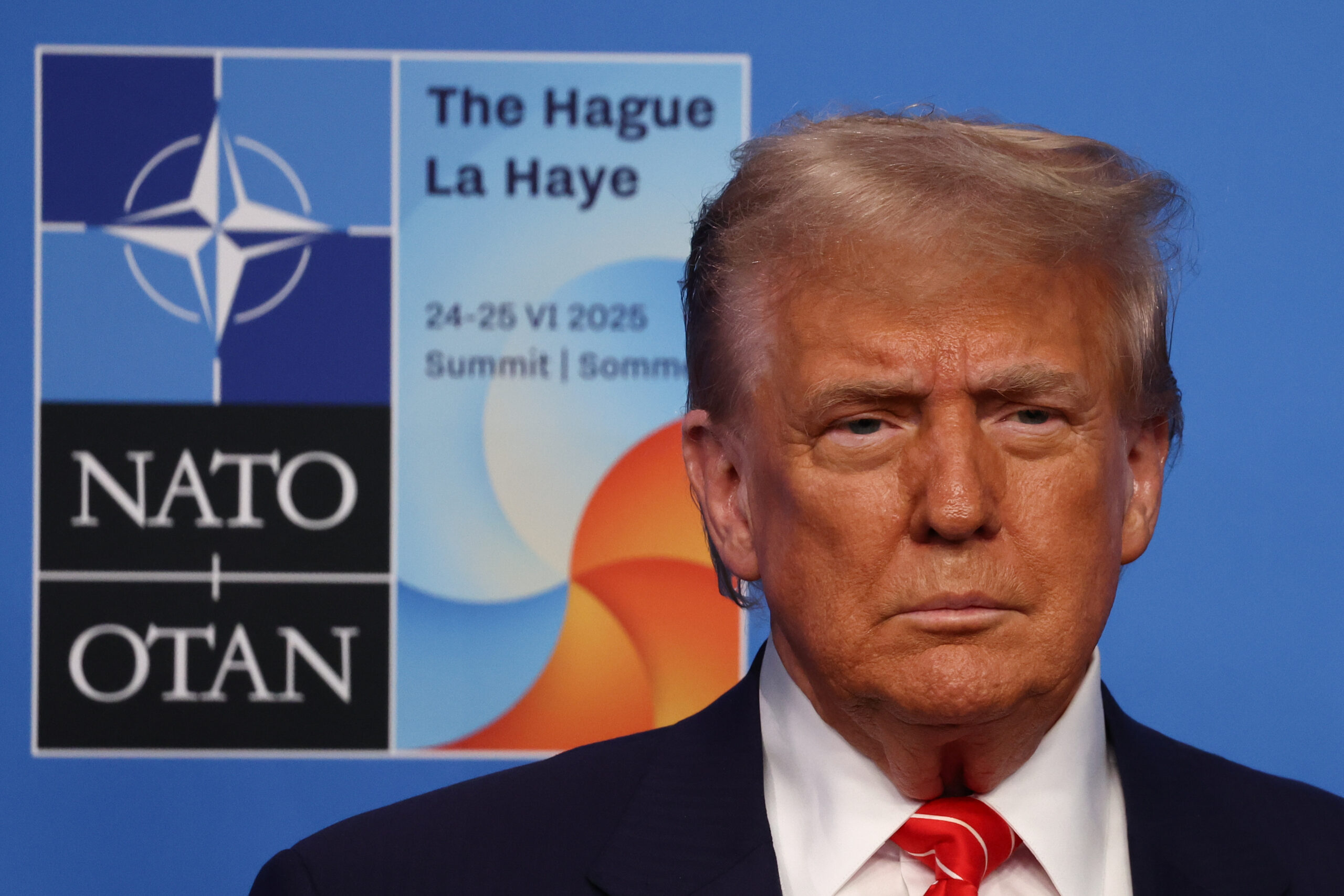
The U.S. war in Iran may be over, or at least in abeyance, but President Donald Trump isn’t done blaming Europeans for his failure there. A week after threatening to quit NATO over European states’ reluctance to help out, especially in clearing the Strait of Hormuz, and just two days after striking a shaky ceasefire deal, the president was at it again Thursday, berating the strategically obsequious Mark Rutte, NATO’s secretary general, for the allies’ inaction.
After the meeting Trump took to Truth Social, lamenting, in all caps, that “NATO WASN’T THERE WHEN WE NEEDED THEM, AND THEY WON’T BE THERE IF WE NEED THEM AGAIN.” Rutte, for his part, dutifully went about trying to get NATO to pledge some sort of support for a Strait of Hormuz mission. The trouble is that Iran is still effectively blocking the Strait, and few if any European states seem eager to clear it by force, whereas they might agree to patrol it uselessly when the danger has passed. So the ceasefire, even if it lasts, probably won’t protect NATO from Trump’s wrath.
The White House is reportedly considering moving U.S. troops out of the most recalcitrant European nations into more cooperative ones. And Trump continues threatening to simply announce a U.S. exit from the alliance. That prospect caused a cascade of concern last week, with Washington’s transatlanticists insisting that exiting NATO would be catastrophic for American security. Senate leaders hastened to reassure allies that Trump cannot unilaterally pull out. Mitch McConnell (R-KY) and Chris Coons (D-DE), leaders of the Senate Foreign Relations Committee, declared that NATO underpins U.S. security and that “the United States will remain in” it. Senate Minority Leader Chuck Schumer (D-NY) reminded everyone that Marco Rubio, now Secretary of State, sponsored the 2023 law requiring two-thirds of the Senate to sign off before the United States can withdraw from NATO.
These critics are doubly wrong. First, Congressional legislation or no, nothing is stopping Trump from pulling the United States out of the web of political commitments that constitute the biggest dangers to Americans posed by NATO. Second, he should undermine the U.S. commitment to the alliance. Trump’s latest reason for being angry at European allies is misguided, but his enduring desire to distance the United States from NATO is useful—a spur to reduce Europe’s dependence on the United States.
The United States does not need to exit NATO to damage it; we could just stop showing up. U.S. forces could stop leading NATO commands (something that has already started), start participating less in NATO planning, and downsize the American presence in Brussels without formally withdrawing. Call it the Irish Goodbye.
Focusing on the question of withdrawal overlooks how the formal, legal U.S. commitment to the alliance is quite limited. It is the political theology surrounding the alliance—the belief that the U.S. military and its nuclear arsenal are automatically available to fight for all members—that holds it together today. Accordingly, Trump could bring the whole edifice of NATO down without laying a glove on the treaty itself.
Article 5 of the Washington Treaty, which today is widely treated as a U.S. commitment to “defend every inch of NATO territory,” says nothing of the sort. Instead, it stipulates that an attack on one member shall be treated as an attack on all, and that in that event, each signatory will take “such action as it deems necessary, including the use of armed force, to restore and maintain the security of the North Atlantic area.” As the historian Marc Trachtenberg has pointed out, the American policymakers who helped found NATO made clear, repeatedly and under oath, that Article 5 did not commit the United States to go to war for the allies. Secretary of State Dean Acheson testified in 1949 that Article 5 did “not mean that the United States would automatically be at war if one of the other signatory nations were the victim of an armed attack.” The United States could hold up its Article 5 legal commitment by sending flowers to the victims of aggression.
Further, though it may seem quaint today, Article 11 makes clear that any action taken by members will be “in accordance with their respective constitutional processes.” For example, if a state’s constitution said the legislature had the power to declare war, the treaty did not circumvent those domestic laws.
So Trump’s threat to withdraw from the Washington Treaty, and the efforts to make sure the United States stays a signatory, is largely beside the point. Trump could just announce that the United States will interpret Article 5 literally, no longer planning to fight wars on behalf of NATO allies. If he followed through by beginning to withdraw American military forces from Europe, it would drive home the shift, taking a leaf blower to the ethereal political beliefs surrounding the alliance.
The Europeans’ refusal to help the United States and Israel in their foolish war of aggression against Iran is sensible. But Trump’s latest diatribe against NATO should be seen as a symptom of legitimate U.S. concerns about the nature of the alliance. The United States’ supposed interest in fighting a war against Russia for Europeans may be an article of near-religious faith in NATO capitals, but it is increasingly a product of smoke and mirrors wielded by the transatlantic foreign policy establishments—a romantic commitment that doesn’t reflect current American interests or the present-day balance of power in Europe.
There are several reasons why the United States commitment to Europe, with its massive price tag and terrible risks, simply isn’t worth it. First, Russia isn’t much of a threat to the core of NATO Europe, much less the United States proper. Even before it ran aground in Ukraine, it was evident that Russia’s capability, whatever its intent, did not allow it to reconstitute its Soviet empire, let alone threaten the heart of Europe. Given European capabilities and motivation if attacked, the notion that almost 100,000 U.S. troops and nuclear threats are needed to keep them safe and free is misguided.
Second, those forces and the U.S. commitments backing them are a major obstacle to the Europeans doing more to balance Russian threat on their own. Paper pledges made to placate Trump notwithstanding, the U.S. presence is a massive disincentive for the Europeans to reorganize to depend less on American help.
Third, the U.S. commitment to defend Europeans is increasingly non-credible. The core interest that caused the United States to form NATO and defend Europe—denying the Soviets West Germany—was profound for historically obvious reasons. This circumstance made it credible that the United States would fight for its allies.
Today the stakes for the United States in Europe are far lower, and hence the U.S. threats underpinning NATO less believable. Why risk nuclear annihilation for a Baltic state, or even Poland? Trump’s occasional shots at NATO, even if they come for strange reasons, are more testament to this underlying reality than its cause.
Denying the rot at the heart of NATO means keeping Europe reliant on a failing foundation. That is a bad idea for Americans, who encourage learned helplessness in European capitals. It is perhaps worse for Europeans, who become delusional about the true sources of their security and neglect the places it needs enhancing.
Trump is wrong to blame European allies for not supporting the war in Iran, but making them sweat about the U.S. commitment to NATO is nevertheless useful. His complaints reflect divergent interests, not just the frustration of one intemperate politician.
The post Threatening NATO Over Iran Is Stupid, but Potentially Useful appeared first on The American Conservative.