Over the past several weeks, under the pretense of stopping the flow of drugs, especially fentanyl, into the United States, the Trump administration has lethally bombed 28 small boats that were allegedly running drugs, killing 104 people. Discarding its disguise as a war on drugs, this month the U.S. seized two oil tankers off the coast of Venezuela. The targets and the increased pressure made it plain that the real goals were regime change and gaining access to Venezuela’s oil.
Regime change has been an explicit goal of the U.S. in Venezuela since the short-lived coup against President Nicolás Maduro’s predecessor, Hugo Chávez, in 2002. In her Vanity Fair interview, White House chief of staff Susie Wiles says that Trump’s Venezuela strategy is “to keep on blowing boats up until Maduro cries uncle.” In November, Trump told Maduro to resign and leave the country.
And gaining access to Venezuela’s oil has long been a goal of Trump. In a June 2023 speech, Trump said, “When I left, Venezuela was ready to collapse. We would have taken it over. We would have gotten all that oil. It would have been right next door. But now, we’re buying oil from Venezuela. So, we’re making a dictator very rich. Can you believe this? Nobody can believe it.” In 2019, when Trump supported the opposition figure Juan Guaidó in a planned coup against Maduro, he pressured him to commit to granting the U.S. access to Venezuela’s oil.
Dramatically intensifying the pressure on Venezuela, last week Trump published a Truth Social post calling Venezuela “a FOREIGN TERRORIST ORGANIZATION” and ordered “A TOTAL AND COMPLETE BLOCKADE OF ALL SANCTIONED OIL TANKERS going into, and out of, Venezuela.”
There are three very large problems with Trump’s blockade.
The first pertains to the justification. Though there is no universally agreed-upon definition of terrorism, many scholars argue that terrorist organizations have to be nonstate actors. So, it is not entirely clear that a country or its government can be designated as a terrorist organization.
Trump designated Venezuela a terrorist organization, in part, because of “drug terrorism.” The day before his Truth Social post, Trump designated fentanyl as a weapon of mass destruction, based on the claim that “fentanyl is closer to a chemical weapon than a narcotic.” Trump asserted that fentanyl “threatens our national security” and that there exists “the potential for fentanyl to be weaponized for concentrated, large-scale terror attacks.”
It is true that fentanyl kills Americans. But there is an essential difference between terrorists and drug distributors. A terrorist’s intent, by the generally accepted definition, is to “spread fear among the population” in order to “coerce a national or international authority to take some action, or to refrain from taking it.” A drug distributor’s intent is to make money. They are both criminal, but they are not identical.
Marjorie Cohn, professor emerita at Thomas Jefferson School of Law and the former president of the National Lawyers Guild, explained to me that, however you define terrorism, “Trump’s designation of the Venezuelan government as a foreign terrorist organization has no legal meaning in international law because the U.S. has no right to enforce its domestic law in the territory or off the coast of another state.”
The second problem with Trump’s sanctioning of oil tankers and his blockade of Venezuela is that it is illegal. According to United Nations General Assembly resolution 3314 (XXIX), “the blockade of the ports or coasts of a State by the armed forces of another state” qualifies as an act of aggression. When the U.S. imposed a blockade on Cuba, a 1961 Justice Department memo noted that “a blockade is a belligerent act which, as a matter of international law, is ordinarily justified only if a state of war, legal or de facto, exists.”
Article 41 of the UN Charter reserves for the Security Council the right to “decide what measures not involving the use of armed force are to be employed,” including the “complete or partial interruption of economic relations.” Only the Security Council can impose sanctions. Cohn explained that “when a state imposes sanctions without Security Council approval, they are called unilateral coercive measures, which violate the UN Charter.” Both the sanctions on oil vessels and the blockade are illegal, and the blockade constitutes an act of war.
The third problem is that the overall campaign against Venezuela of which the blockade is an important component does not protect U.S. interests because the charges against Venezuela are a fantasy. The Trump administration has consistently claimed that the pressure being exerted on Venezuela and on Maduro are about fentanyl. In his Truth Social post, Trump charged Venezuela with “theft of our Assets,” including oil, and with using that oil to finance the “Drug Terrorism” of flooding the U.S. with fentanyl. Trump says that the U.S. “Armada… will only get bigger, and the shock to them will be like nothing they have ever seen before — Until such time as they return to the United States of America all of the Oil, Land, and other Assets that they previously stole from us.”
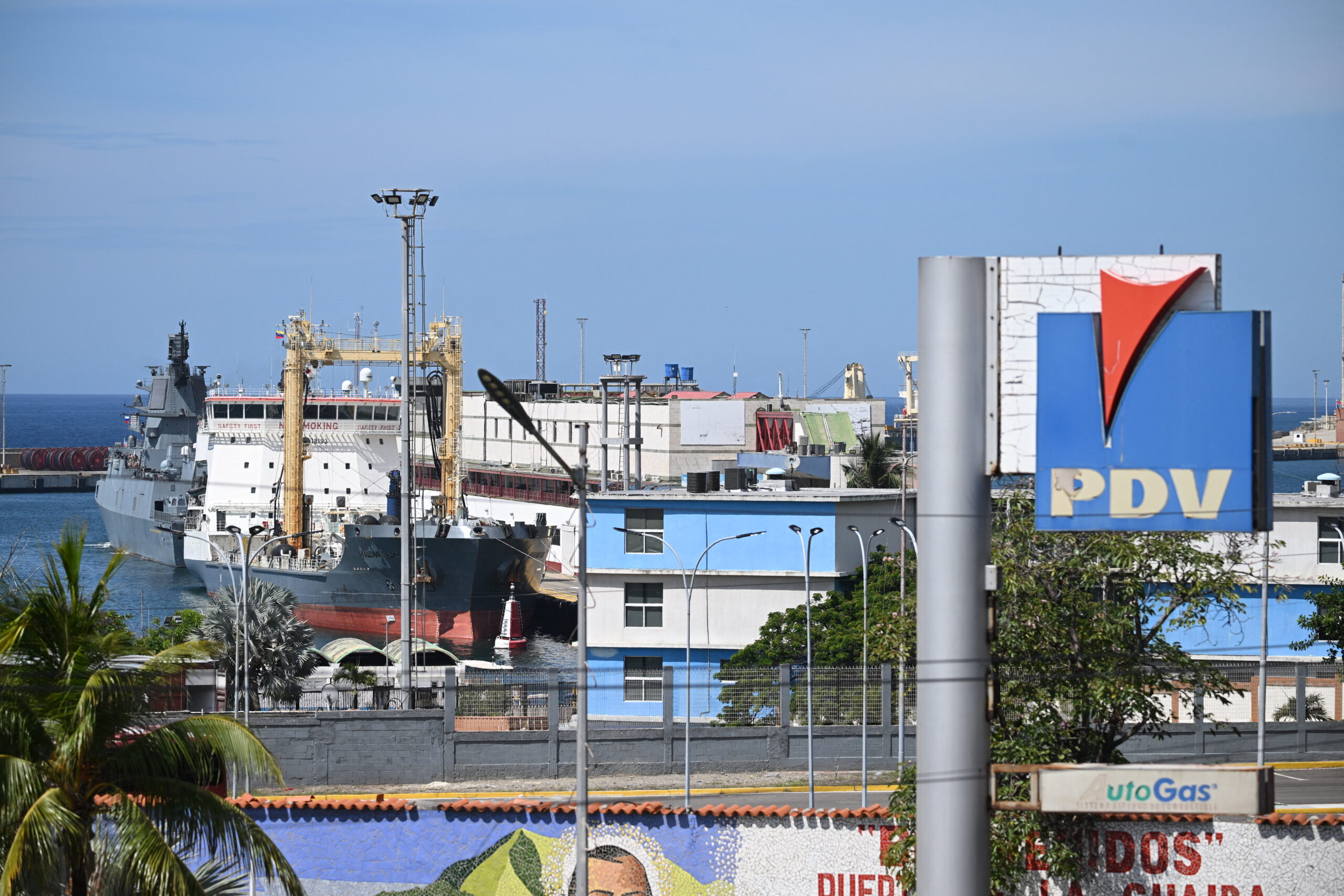
It is not clear to what Trump is referring when he accuses Venezuela of stealing American “Oil, Land, and other Assets.” It is not at all clear how the oil under Venezuelan ground can be American. Nor is it clear what land and other assets Trump is referring to. The oil reference may be to Venezuela’s nationalization of its natural resources. At the time, the popularly elected Hugo Chávez promised that his “government is here to protect the people, not the bourgeoisie or the rich.” With that promise, he nationalized the electricity, telecommunications, and steel industries to divert the profits from Venezuelan resources into social programs for Venezuela’s people. Most importantly, Chávez nationalized the oil and natural gas partnerships the Venezuelan state oil company PDVSA had made with mostly American corporations. But that is not theft, and it is not uncommon.
And Venezuela is not a significant source of the fentanyl or other drugs that flow into the United States. Contrary to the Trump administration’s claims, Washington does not believe that Maduro is the head of Venezuela’s drug cartels. An April 7 sense of the community memorandum put together by the Office of the Director of National Intelligence and reflecting the findings of the 18 agencies in the U.S. intelligence community concluded that “the Maduro regime probably does not have a policy of cooperating with [the cartels] and is not directing [their] movement to and operations in the United States.” The memorandum said that the intelligence community “has not observed the regime directing” drug cartels and that the Maduro government, in fact, “operate[s] against it in ways that make it highly unlikely the two sides would cooperate in a strategic or consistent way.”
Nor does Washington believe that Venezuela is the source of other types of drugs that kill Americans. U.S. officials say that the small boats that have been struck in the passageway between Venezuela and Trinidad and Tobago are not carrying fentanyl, but marijuana and a small quantity of cocaine, bound for West Africa and Europe. According to the U.S. Drug Enforcement Administration, 90 percent of the cocaine that transits into the U.S. enters through Mexico, not Venezuela.
The U.S. blockade on Venezuela’s sanctioned oil tankers is illegal. It is an act of war that is based on false charges. Though it is hoped to bring about a coup that will usher in a pro-American government that opens Venezuela’s resources to the United States, the more likely outcome is mayhem and instability. Trump’s order of a blockade caught senior officials at the Pentagon by surprise, and they are unsure of what role the U.S. military is expected to play. But on the day after the order, three ships left Venezuela carrying oil-based products. This time, they were escorted by Venezuelan naval ships. That is a dangerous scenario that could accidentally or intentionally lead to a full-scale war that does not serve Americans’ interests.
The post Three Big Problems with Trump’s Venezuela Oil Blockade appeared first on The American Conservative.