
Israel Runs the Iran Playbook on Turkey
Yesterday’s peripheral partnerships are today’s rivalries.
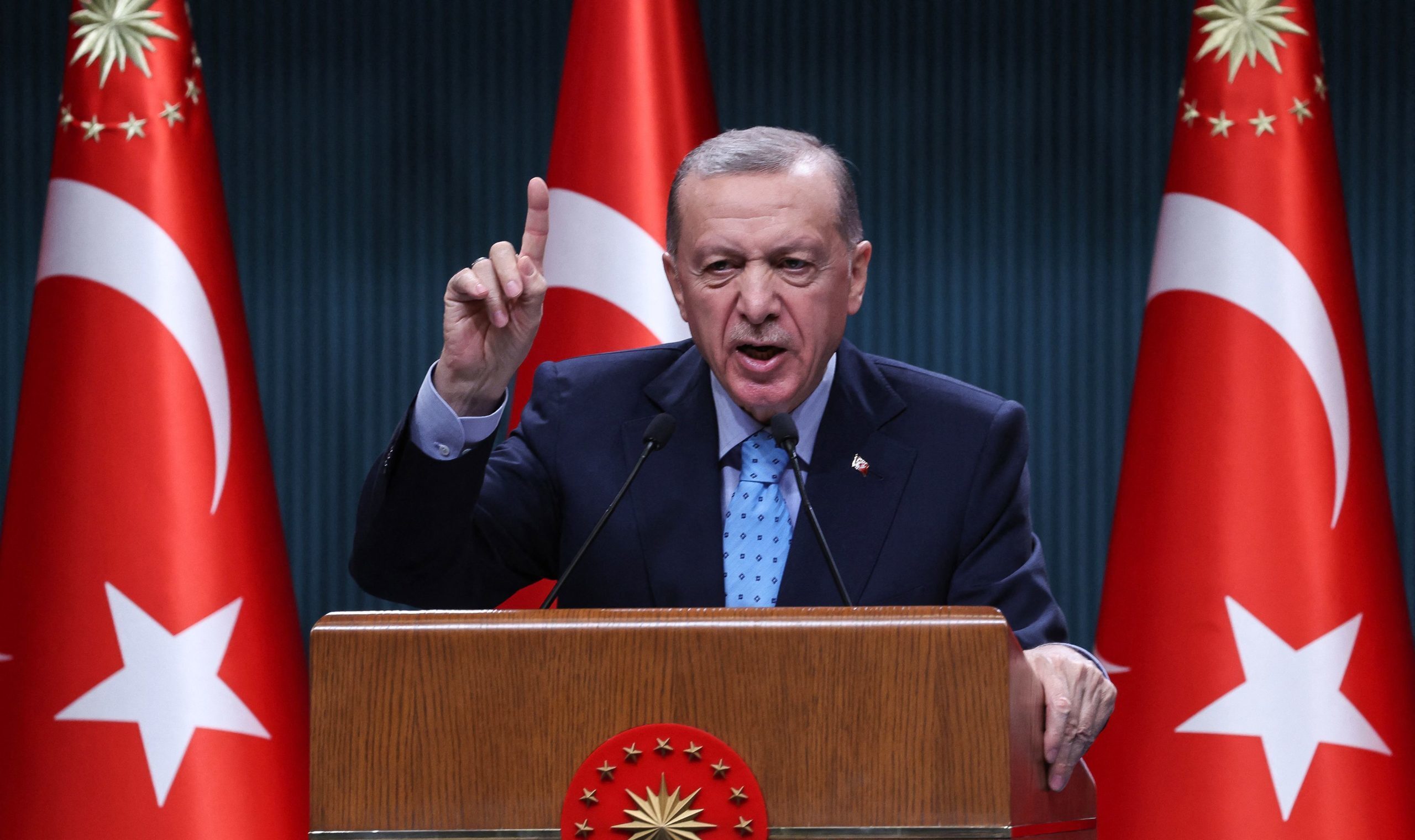
One of the stranger geopolitical developments in the Middle East of late (leaving aside the present war) has been the rupture between Israel and Turkey. A war of words has turned into something resembling a full diplomatic spat, with Israel’s Prime Minister Benjamin Netanyahu describing Turkey’s regional aspirations as “aggressive” and other high officials even advocating for the country’s removal from NATO.
Most worrying, considering the conflict in which the United States currently finds itself embroiled, are Israeli comparisons of Turkey to Iran. The former Israeli Prime Minister Naftali Bennett, for instance, has declared that “Turkey is the new Iran,” which seems to portend a confrontation with Ankara.
From a historical perspective, this is surprising. Turkey recognized Israel less than a year after the latter declared its independence, becoming the first major Muslim-majority country to do so. Turkey, along with Pahlavist Iran, played an important role in Israel’s “Alliance of the Periphery,” which sought close ties with non-Arab states on the outer reaches of the Middle East, such as Turkey and Iran, as a counterweight to the Arab states more geographically proximate and hostile to Israel.
As a result, for decades Israel maintained strong linkages with Turkey. Israelis still have access to visa-free travel to Turkey. The two countries had significant military ties until the early 2010s, with Turkey even considering procuring Israeli air defense systems. Until 2024 (when Turkey cut off trade due to the Gaza War), they had a valuable trade relationship as well. The two countries also assisted each other with natural disaster relief, such as during Israel’s 2010 Mount Carmel fire, or after Turkey’s massive 2023 earthquakes.
Israeli-Turkish cooperation has historically extended to the lobbying efforts of both countries in Washington, with parts of the Israel lobby historically acting as “enthusiastic boosters” for Turkey.
Both Turkey and Israel tended to find themselves on the same side of geopolitical issues outside the Middle East. In the Caucasus, Israel cultivated close ties with Azerbaijan—a Turkish client, and the perennial antagonist of Turkey’s enemy Armenia—since the breakup of the USSR in 1991. In the Nagorno-Karabakh War of 2020 and in Azerbaijan’s 2023 offensive, both Turkish and Israeli weapons played a significant role in Azerbaijan’s military successes. In the weeks before the 2023 offensive, Azerbaijani military cargo planes flew to an Israeli airbase 13 times, presumably to carry arms back to Azerbaijan. While Azerbaijan’s President Ilhan Aliyev has complained about the deteriorating relations of his two benefactors, it is unlikely that such close ties between Israel and Azerbaijan would have been possible to be cultivated without Israel’s prior relationship with Turkey.
Israel’s collaboration with Turkey has even extended to Israel tending to take the Turkish side in contemporary debates about the Armenian genocide. Israel’s Knesset, including under Netanyahu, historically blocked bills recognizing the Armenian genocide. (Israel currently appears to be shifting its position on the Armenian genocide due to deteriorating relations with Turkey.)
This long-term cooperative relationship between Turkey and Israel was at the same time punctuated occasionally by mutual criticism, and Turkish rhetorical anti-Zionism, as well as more tangible disputes, such as Turkey’s suspension of military ties with Israel following an Israeli raid which killed nine Turkish civilians in 2011. But these did not prevent both countries from pursuing their common interests.
Given this long history of ties between the two countries, it comes as a surprise for Israeli politicians to declare that Turkey is the “New Iran” or to try to stop the U.S. from selling F-35s to Turkey. Yet, in many respects, Israel’s relationship with Turkey is following the pattern established by Israeli–Iranian relations.
Contrary to popular belief, the Iranian Revolution of 1979, and the replacement of Pahlavist Iran with the Islamic Republic, was not the main rupture point in Iranian–Israeli tensions. Despite Supreme Leader Ruhollah Khomeini’s rhetorical anti-Zionism, Iran maintained deep ties with Israel, with Israel being Iran’s main foreign supplier during the Iran–Iraq War and Iranian intelligence possibly enabling Israel’s successful bombing of the Osirak Reactor. Despite the ideological differences between Israel and Iran, both were brought closer together by common threats such as the Ba’athist Iraq and the USSR.
Israeli–Iranian tensions largely increased in the 1990s as these threats waned, even though Iran was going through significant ideological moderation. As Trita Parsi, whose book Treacherous Alliance covers this aspect of the Iran-Israel rivalry, told The American Conservative:
At the heart of it [the Iran–Israel rivalry] is Israel’s insistence that its only path to security is by dominating the region militarily. No country in the region, or combination of countries, can be allowed to outgun Israel. Israel needs to deter everyone in the region, while no one should be allowed to deter Israel. As such, it is Iran’s power that is the main challenge to Israel, not its ideology. Indeed, at a moment when Iran’s ideology was in decline in the mid-1990s, Israel suddenly started to depict Iran as the main threat in the region. It was a very sudden shift. The reason was that the two key factors that had brought Iran and Israel closer together in earlier decades, the common threat from the Soviet Union and from strong Arab nationalist countries, such as Iraq under Saddam Hussein, had both evaporated. And a new embryonic, bipolar geopolitical situation was emerging in which Iran and Israel were the two most powerful countries in the region with no buffers in between them. To make matters worse, the Israelis feared that if the U.S. reconciled with Iran, Israel’s strategic value to Washington would diminish while America’s support for Israel against Iran would be in jeopardy.
Similarly, the Turkish-Israeli relationship was kept alive for structural reasons inherent to the region’s geopolitical order, despite the differences between both Turkish and Israeli society and occasional mutual criticisms between the two countries. Both the Turks and Israelis shared common foes in the Soviet Union, Ba’athist Iraq, and (most recently) Iran. Indeed, the longstanding tensions and hostility between Iran and Azerbaijan play a major role in Israel’s support for Baku and is a major source of Turkish–Iranian tensions.
When those structural conditions changed, the glue holding the relationship together dissolved. The shriveling of Iranian influence in the Levant following the fall of Syria’s Assad regime and the weakening of Hezbollah, together with the seemingly decisive victory of Azerbaijan over Armenia in the 2020 war, eliminated the commonality of interest that had brought the two powers together. As with Iran in the 1990s, Israel has increasingly turned on its former partner Turkey, seeing it as a potential rival to Israeli military supremacy.
“What we are seeing now between Israel and Turkey is reminiscent of Israel’s shift on Iran,” Parsi told The American Conservative with regard to this historical comparison. “As Turkey rose in power because of its success in Syria, and Iran appeared to have weakened, the rhetoric in Israel started to turn against Turkey.”
Parsi continued,
Suddenly, Erdogan was described as the most dangerous person in the Middle East. Turkey, who never has deployed the Islamic Republic’s rhetoric against Israel and has had long intelligence ties with Israel—back in the 1990s when Israel and Turkey were close, AIPAC was training a Turkish lobby in Washington—was now being treated as if it posed an even greater threat to Israel than Iran. Not much had changed in Turkey—except, of course, Turkey had grown more powerful and was seen as an obstacle to Israel’s designs for regional hegemony.
While it is unclear where Turkish–Israeli relations will go—though further deterioration is likelier than not—it is important to ensure that Israeli (or Turkish) interests, to the extent these diverge from our own, do not shape American policy-making. We have little reason to fear Turkey as a potential regional aggressor; our approach should be conditioned by a clear-eyed view rather than Israeli concerns and fears.
In the Middle East, the past two decades have been the story of the American people wanting one thing, withdrawal, and their government giving them another. Many of our recent entanglements are connected with the policies and interests of the Israeli government, particularly its views and fears concerning regional rivalries. If tensions should rise between Israel and Turkey, Washington should stay as far removed as possible.
The post Israel Runs the Iran Playbook on Turkey appeared first on The American Conservative.